
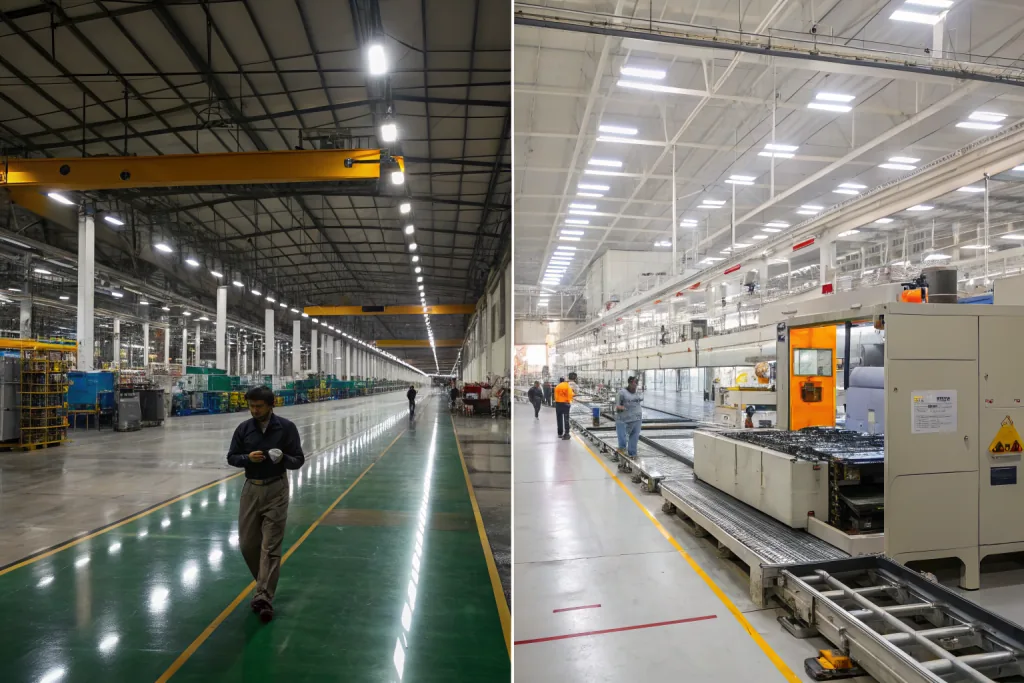
For most small and medium businesses looking to source manufactured products, China remains the better choice due to its superior infrastructure, lower production costs (15-30% cheaper on average), shorter lead times, and more mature supply chains. However, India is becoming increasingly competitive in specific product categories like textiles, pharmaceuticals, and IT services, making the decision dependent on your specific product type and business requirements.
As global trade patterns shift and businesses seek to diversify their supply chains, understanding the key differences between sourcing from China versus India has become critical for making informed procurement decisions. This comprehensive comparison will help you determine which country aligns best with your business goals.
China vs India Manufacturing: Key Specifications Comparison
| Factor | China | India |
|---|---|---|
| Average Production Cost | Baseline (100%) | 15-25% higher |
| Typical MOQ | 500-1,000 units | 1,000-2,000 units |
| Lead Time | 25-35 days | 35-50 days |
| Shipping to US (20ft container) | $2,500-$4,000 | $3,500-$5,500 |
| Quality Consistency Rating | 8.5/10 | 7/10 |
| English Proficiency (suppliers) | Moderate (6/10) | High (8.5/10) |
| Infrastructure Rating | 9/10 | 6.5/10 |
| Payment Terms Flexibility | 30% deposit, 70% before shipping | 40-50% deposit common |
Is India or China a Better Investment?
China represents a better investment for most product categories due to its established manufacturing ecosystem, 15-30% lower production costs, and significantly better infrastructure. The numbers clearly demonstrate China’s advantages: Chinese manufacturers can produce electronics, home goods, and consumer products at prices that Indian suppliers typically cannot match without compromising on quality or specifications.
However, the investment equation depends heavily on your specific product category and long-term business strategy. India shows stronger competitiveness in several niches:
- Textiles and apparel: India offers comparable pricing (within 5-10% of China) with excellent craftsmanship, particularly in cotton garments, traditional textiles, and handcrafted items
- Pharmaceutical ingredients: India produces approximately 20% of global generic drugs and offers 30-40% cost savings compared to Western suppliers
- IT and software services: India dominates with 55% of the global outsourcing market share
- Leather goods: India is the second-largest exporter globally, with competitive pricing on genuine leather products
From a risk management perspective, India offers the “China Plus One” strategy advantage. Diversifying your supply chain between both countries can reduce dependency on a single nation, though this typically requires larger order volumes to maintain economies of scale. Businesses ordering 5,000+ units annually can effectively split production between countries, while smaller operations should focus on one primary source.
How is Outsourcing in India Different to China?
Outsourcing in India differs from China primarily in three areas: India excels in service-based outsourcing and English communication but lags in manufacturing infrastructure, while China dominates physical product manufacturing with superior supply chain integration but requires more communication effort.
Manufacturing Infrastructure and Ecosystem
China’s manufacturing infrastructure represents decades of focused investment and development. The country hosts over 150,000 factories in Guangdong Province alone, creating dense industrial clusters where a complete supply chain for electronics, textiles, or home goods exists within a 50-mile radius. This clustering reduces lead times by 20-30% compared to India, where component sourcing often requires coordination across multiple distant states.
India’s infrastructure challenges manifest in several practical ways. Port congestion adds 5-10 days to shipping schedules compared to China’s efficient ports in Shenzhen, Shanghai, and Ningbo. Domestic logistics within India cost approximately 14% of GDP versus 8% in China, directly impacting your landed costs. Power reliability remains inconsistent in many Indian manufacturing regions, with factories requiring backup generators that increase operational costs by 8-12%.
Communication and Business Culture
Indian suppliers generally offer superior English communication, with most factory managers speaking fluent business English. This contrasts with China, where language barriers remain common outside major export hubs. However, this advantage primarily benefits initial negotiations rather than production execution.
Business culture differences significantly impact operations. Chinese suppliers typically demonstrate more flexibility with product modifications and customization once relationships are established. Indian manufacturers often adhere more rigidly to established processes, making custom product development 15-20% more time-consuming. Chinese factories commonly work with 7-day production schedules during peak seasons, while Indian manufacturers more strictly observe weekends and religious holidays, potentially extending lead times.
Quality Control and Standards
Quality consistency favors China for most manufactured goods. Chinese factories have matured through decades of serving demanding Western clients, implementing robust QC systems. Third-party inspection failure rates average 12-15% in China versus 18-25% in India for comparable product categories. This gap narrows in India’s specialty sectors like textiles and pharmaceuticals, where quality matches or exceeds Chinese standards.
Working with an experienced China sourcing agent like Mangors Sourcing significantly mitigates quality risks through comprehensive supplier vetting, on-site inspections, and quality control processes. Our team conducts pre-production, during-production, and pre-shipment inspections to ensure your products meet specifications before leaving the factory.
What is the Best Thing to Import from China to India for Business?
The most profitable products to import from China to India are electronics and consumer electronics accessories, smartphone components, industrial machinery, and chemical products, with electronics accessories offering margins of 40-60% due to China’s 25-35% lower manufacturing costs.
For entrepreneurs considering the China-to-India import corridor specifically, these categories demonstrate the strongest opportunity:
- Electronics and accessories (45-60% margin potential): Mobile phone accessories, chargers, power banks, headphones, and smart home devices. China produces these at 30-40% lower costs than Indian manufacturers. A smartphone charger costing $0.80 in China might cost $1.30-1.50 to produce in India, creating substantial arbitrage opportunities.
- Industrial machinery and equipment (30-40% margins): CNC machines, packaging equipment, and manufacturing tools. Chinese machinery costs 25-35% less than equivalent Indian-made equipment while offering comparable quality for most applications.
- Solar panels and renewable energy components (35-50% margins): China dominates solar manufacturing with 70% global market share and prices 30-45% below Indian production costs.
- Toys and children’s products (40-55% margins): China’s specialized toy clusters in Guangdong produce items at costs Indian manufacturers cannot match, typically 35-50% lower for comparable quality.
- Home textiles and furnishings (30-45% margins): While India excels in cotton textiles, China leads in synthetic blends, printed fabrics, and finished home goods at 20-30% lower prices.
Market Considerations for China-to-India Imports
Import duties significantly impact profitability. India imposes tariffs ranging from 10% to 30% on various Chinese goods, with recent policy shifts potentially affecting specific categories. Electronics components typically face 10-15% duties, while finished consumer electronics may incur 20-25% tariffs. These rates change periodically based on bilateral relations and domestic policy objectives.
Despite tariffs, the 25-35% manufacturing cost advantage in China often allows profitable imports. However, successful India-focused importers typically order containers of 500-1,000 units minimum to achieve economies of scale that offset tariff costs. Smaller shipments rarely prove economical unless targeting ultra-premium segments with 100%+ retail markups.
Making the Right Choice: China or India for Your Business
Your optimal sourcing decision depends on specific business parameters. Choose China when:
- Manufacturing electronics, home goods, machinery, or consumer products requiring complex supply chains
- Seeking lowest possible production costs (15-30% savings typical versus India)
- Requiring MOQs under 1,000 units for initial orders
- Prioritizing fast turnaround times (25-35 days typical lead times)
- Needing extensive customization options and product development support
Consider India when:
- Sourcing textiles, apparel, leather goods, or pharmaceutical ingredients where India demonstrates competitive advantages
- English communication is absolutely critical to your operation
- Implementing a “China Plus One” diversification strategy with sufficient order volume (5,000+ units annually)
- Targeting the Indian domestic market where local sourcing provides tariff advantages and faster delivery
For most small and medium businesses importing to US and European markets, China remains the optimal choice for 75-80% of product categories. The combination of lower costs, better infrastructure, shorter lead times, and mature quality control systems creates compelling advantages that India has not yet matched for physical product manufacturing.
Partner with Experts for Successful China Sourcing
Successfully sourcing from China requires more than identifying the right country—it demands experienced guidance through supplier selection, negotiation, quality control, and logistics. Mangors Sourcing specializes in helping small and medium businesses navigate the complexities of Chinese manufacturing. Our full-service approach includes rigorous supplier vetting to identify reliable manufacturers, comprehensive quality control with on-site inspections at critical production stages, competitive shipping arrangements, and customs clearance support to ensure smooth delivery.
With years of experience and a network of verified Chinese suppliers across dozens of product categories, we eliminate the risks and guesswork from China sourcing. Whether you’re placing your first order or scaling an existing product line, our team provides the local expertise and quality assurance that turns China sourcing from a challenge into a competitive advantage.
Ready to start sourcing from China with confidence? Contact Mangors Sourcing today for a free consultation. We’ll assess your specific product requirements, provide detailed cost analysis, and connect you with pre-vetted suppliers who match your quality standards and budget. Let our expertise in China sourcing become your shortcut to successful importing.