
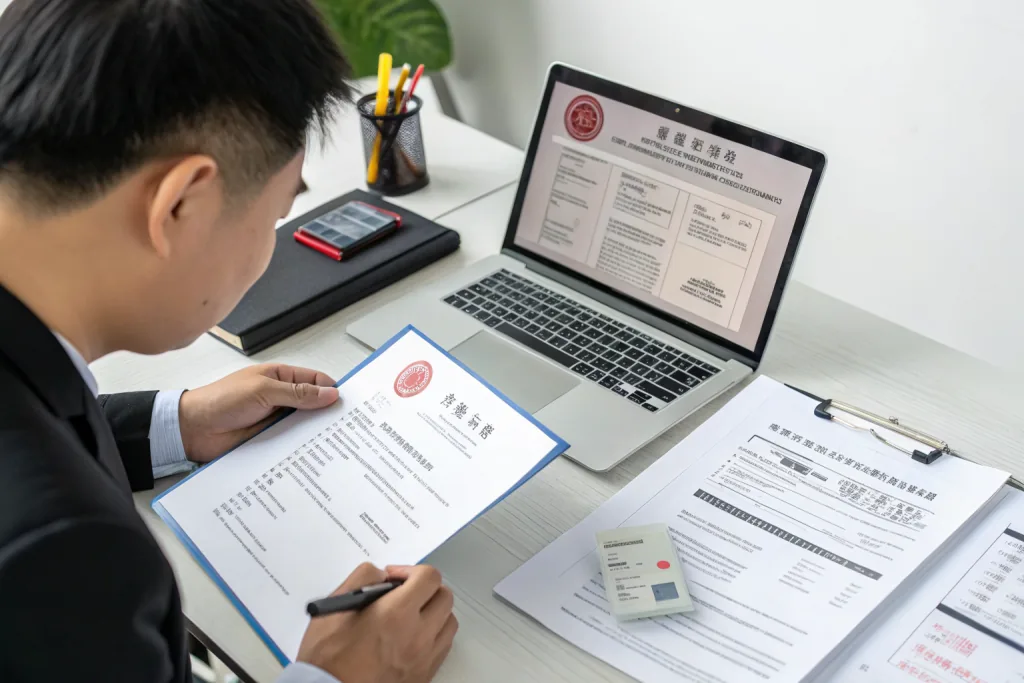
To properly vet a Chinese supplier before placing an order, verify their business license and export credentials, request and check customer references, conduct a factory audit (virtual or in-person), order product samples, and confirm production capacity matches your order requirements. This systematic verification process reduces the risk of fraud, quality issues, and delivery delays when sourcing from China.
Working with Chinese manufacturers offers significant cost advantages—typically 30-60% lower than domestic production—but requires thorough due diligence. According to industry data, approximately 15-20% of first-time importers experience issues with unvetted suppliers, ranging from product quality problems to outright fraud. The good news is that most problems are preventable with proper supplier verification.
Step 1: Verify Business Credentials and Legal Status
Start by confirming the supplier’s legal business registration and export authorization through China’s official business registration database and trade platforms. Request their business license (营业执照), which should display their registered company name, legal representative, registered capital (typically ¥500,000-¥5,000,000 or $70,000-$700,000 for legitimate manufacturers), and business scope.
Key documents to verify include:
- Business License: Confirms legal registration with the Chinese government
- Export License: Required for companies to export goods (not all factories have this)
- Tax Registration Certificate: Proves the company pays taxes and operates legitimately
- Quality Certifications: ISO 9001, ISO 14001, or industry-specific certifications
- Product Certifications: CE, FDA, RoHS, FCC depending on your product category
You can verify business licenses through platforms like qcc.com or tianyancha.com (Chinese business information databases). Many legitimate suppliers will also appear on verified platforms like Alibaba’s Gold Supplier program (costs suppliers $3,000-$6,000 annually) or Global Sources, which conduct basic verification checks.
Step 2: Assess Production Capacity and Factory Capabilities
Request detailed information about the factory’s production capacity, machinery, workforce size, and monthly output to ensure they can handle your order volume and timeline. A factory producing 50,000 units monthly shouldn’t accept a 200,000-unit order with a 30-day deadline.
Ask specific questions:
- What is your monthly production capacity for this specific product?
- How many production lines do you operate?
- What is your current capacity utilization rate? (70-85% is healthy; over 95% may cause delays)
- How many workers are in your factory?
- What quality control systems do you have in place?
For orders with MOQs (Minimum Order Quantities) between 500-1,000 units, ensure the factory regularly handles similar-sized orders. Factories typically specialize in certain order sizes: small-batch manufacturers (100-1,000 units), medium-scale (1,000-10,000 units), or large-scale operations (10,000+ units).
Step 3: Conduct Reference Checks and Due Diligence
Contact at least 2-3 existing customers of the supplier to verify their reliability, product quality, and communication standards before committing to an order. Request references from clients in your region (US or Europe) who have imported similar products within the past 12 months.
When checking references, ask:
- How long have you worked with this supplier?
- What was the defect rate on your orders? (Industry average is 2-4%; under 1% is excellent)
- Did they meet agreed delivery timelines? (Standard lead times: 15-30 days for stock items, 30-60 days for custom production)
- How responsive is their communication?
- Have you encountered any quality or shipping issues?
- Would you place another order with them?
Additionally, search for the company name online, check their website age and professionalism, and review any feedback on trade platforms. Companies operating for 5+ years with consistent positive feedback present lower risk than newly established operations.
Step 4: Order and Evaluate Product Samples
Always order physical samples before placing bulk orders—typically 2-5 samples costing $50-$300 including shipping—to verify product quality, materials, and manufacturing standards match your requirements. Sample costs are usually 2-3 times the per-unit price of bulk orders, and express shipping (DHL, FedEx, UPS) takes 3-7 days at $30-$80 per kilogram.
Evaluate samples for:
| Evaluation Criteria | What to Check | Acceptable Standards |
|---|---|---|
| Material Quality | Material type, thickness, durability, finish | Matches specifications exactly |
| Workmanship | Stitching, assembly, finishing details | No visible defects, consistent quality |
| Functionality | Product performs as intended | Meets all functional requirements |
| Packaging | Protection, branding, labeling | Protects product, professional appearance |
| Measurements | Dimensions, weight, tolerances | Within ±2-5% of specifications |
If samples reveal issues, request modifications and new samples before proceeding. Some suppliers offer sample fees refundable against bulk orders, though this varies by industry and order size.
Step 5: Request and Review a Factory Audit
Conduct a factory audit—either in-person, through a third-party inspection service ($200-$500), or via detailed video tour—to verify manufacturing conditions, quality control processes, and working conditions meet international standards. For businesses unable to travel to China, working with an experienced China sourcing agent like Mangors Sourcing provides on-ground verification and ongoing quality oversight.
Factory audits should assess:
- Production equipment: Modern, well-maintained machinery appropriate for your product
- Quality control systems: Inspection procedures at multiple production stages
- Workplace conditions: Clean, organized, safe working environment
- Storage facilities: Proper material and finished goods storage
- Compliance: Labor practices, environmental standards, safety regulations
What is the 0.1% Rule in China?
The 0.1% rule in China refers to the statistically observed phenomenon that approximately 1 in 1,000 suppliers on major B2B platforms are sophisticated fraudsters who have invested significantly in appearing legitimate. These operations maintain professional websites, verified certifications (sometimes forged), sample inventory, and responsive sales teams—but disappear after receiving payment or deliver substandard goods.
This rule emphasizes why thorough vetting is essential. While 99.9% of suppliers may be legitimate or simply low-quality, that 0.1% can cause devastating financial losses. The average loss from supplier fraud ranges from $5,000-$50,000 for small to medium businesses. Protect yourself by never paying full amounts upfront (standard terms are 30% deposit, 70% before shipment), using secure payment methods like Trade Assurance or letters of credit for orders over $10,000, and conducting in-person or third-party factory verification.
How to Do Pre-Order Business from China?
To successfully conduct pre-order business from China, establish clear payment terms (typically 30-40% deposit with 60-70% balance before shipment), define production timelines with penalty clauses, secure product samples, and create detailed product specifications before accepting customer pre-orders. This approach minimizes financial risk while ensuring you can fulfill customer commitments.
Follow this pre-order workflow:
- Sample Validation (Week 1-2): Order and approve samples, cost $50-$300
- Quote Finalization (Week 2-3): Negotiate final pricing, MOQs, and payment terms
- Launch Pre-Order Campaign (Week 3-6): Market to customers with realistic delivery timelines (add 2-4 weeks buffer)
- Place Factory Order (Week 6): Once minimum pre-orders met, pay 30% deposit ($1,500 on a $5,000 order)
- Production (Week 7-10): Standard production time 30-45 days, with weekly updates
- Quality Inspection (Week 10): Third-party QC inspection before shipment, cost $200-$400
- Pay Balance & Ship (Week 11): Pay remaining 70% ($3,500), arrange shipping
- Receive & Fulfill (Week 13-15): Sea freight 25-35 days, air freight 5-10 days
For pre-order models, build in a 15-20% buffer on delivery timelines to account for potential production delays, customs clearance (typically 3-7 days), and final-mile delivery. Calculate total landed costs including product cost, shipping (sea freight $2-$6 per kg, air freight $4-$8 per kg), tariffs (average 2.5-25% depending on product category and origin), and customs clearance fees ($100-$300 per shipment).
How to Negotiate with a Chinese Supplier?
To effectively negotiate with a Chinese supplier, start by requesting quotes from 4-6 suppliers to establish market pricing, then leverage order volume, payment terms, and long-term partnership potential rather than simply demanding lower prices. Chinese manufacturers typically offer 5-15% discounts for orders 2-3 times their MOQ and another 5-10% for repeat customers with consistent monthly orders.
Effective negotiation strategies include:
- Volume Commitment: “Our initial order is 1,000 units, but we project 5,000 units quarterly if quality meets standards. What pricing can you offer for volume commitment?”
- Payment Terms: Offer faster payment (50% deposit instead of 30%) in exchange for 5-8% price reduction
- Specification Adjustment: Reduce costs 10-20% by simplifying packaging, using alternative materials, or adjusting dimensions slightly
- Competition Leverage: “Supplier B offered $4.20 per unit for similar specifications. Can you match or improve this pricing?”
- Long-term Partnership: “We’re looking for a reliable long-term partner. If this first order succeeds, we’ll place monthly orders of X units.”
Understand that Chinese suppliers typically price with 15-25% profit margins. Requesting 40-50% discounts is unrealistic and damages credibility. Reasonable negotiation targets are 8-15% reductions through the strategies above. Also negotiate non-price terms: shorter lead times (offer premium for priority production), better payment terms (45-day payment instead of pre-shipment), or included services (free warehousing for 30 days, custom packaging, drop-shipping capabilities).
Build relationships through respectful communication, timely responses, and clear specifications. Chinese business culture values long-term partnerships (关系, guanxi), so suppliers often offer better pricing and priority service to established, reliable customers versus one-time buyers constantly seeking the absolute lowest price.
Work with Experienced China Sourcing Professionals
Vetting Chinese suppliers requires time, expertise, and often on-ground presence in China. For small and medium businesses importing from China for the first time, partnering with an experienced China sourcing agent like Mangors Sourcing eliminates much of the risk and learning curve. We provide comprehensive supplier vetting, factory audits, quality control inspections, shipping coordination, and customs support—allowing you to focus on growing your business while we handle the complexities of China sourcing.
Our full-service approach includes verification of all supplier credentials, in-person factory visits, production monitoring, pre-shipment inspections, and ongoing quality assurance. We help businesses avoid the costly mistakes that plague first-time importers and build reliable supply chains that scale with growth.
Ready to source high-quality products from China with confidence? Contact Mangors Sourcing today for a free consultation and learn how we can help you find, vet, and manage reliable Chinese suppliers for your business.