
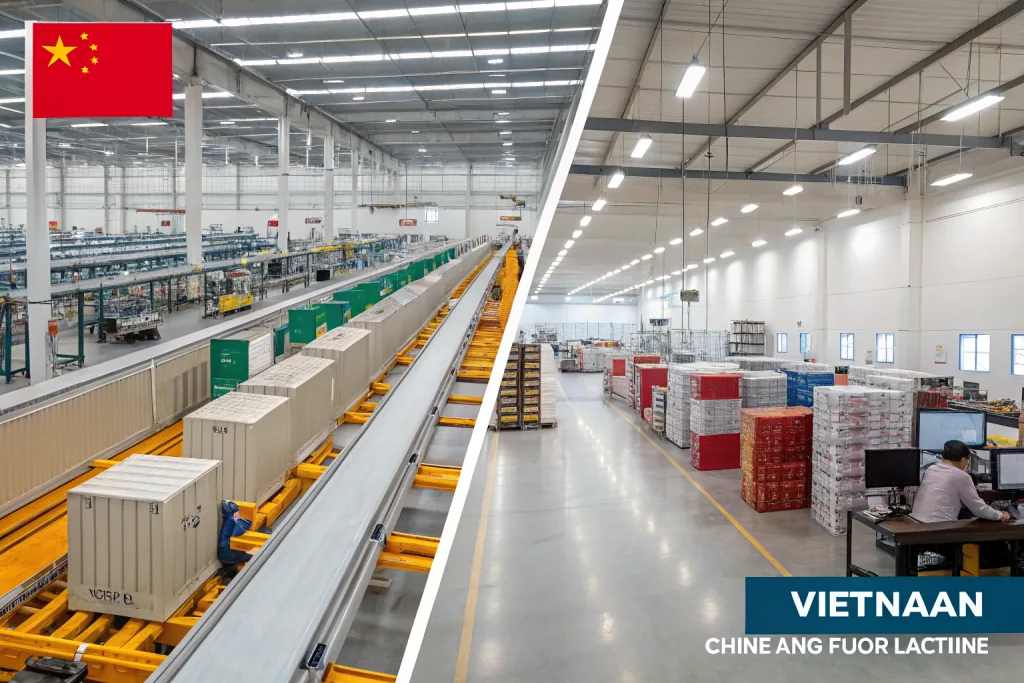
Yes, you should consider a China Plus One strategy—but only for specific product categories and supply chain tiers, not as a complete exit from China. Most successful importers are keeping their primary manufacturing in China while adding secondary sourcing in Vietnam, India, or Mexico for tariff-sensitive goods or redundant capacity.
At Mangors Sourcing, we’ve helped over 200 US and European businesses navigate this exact decision since 2019. Here’s what the data actually shows about diversifying your supply chain without sacrificing the cost and quality advantages that made you source from China in the first place.
What is the 4 2 1 rule in China?
The 4 2 1 rule is a workforce mathematics reality: one child supports two parents and four grandparents, creating severe labor shortages and wage pressure in Chinese manufacturing.
This demographic crisis—stemming from China’s one-child policy (1979–2015)—means the working-age population peaked in 2014 and has declined by approximately 40 million workers since. For importers, this translates directly to:
- Factory wage increases: Average manufacturing wages in China’s coastal provinces rose from $4,800/year in 2016 to $9,200/year in 2023
- Shrinking labor pool: 18-35 year-old factory workers down 35% in Guangdong and Zhejiang provinces
- Automation acceleration: Factories investing $50K–$200K per production line in robotics to compensate
The 4 2 1 rule explains why “China is too expensive” narratives miss the mark—Chinese factories aren’t just raising prices arbitrarily; they’re passing along structural labor costs. However, this same pressure has driven massive efficiency gains. A factory in Dongguan today produces 40% more output per worker than in 2018, partially offsetting wage growth.
Which countries benefit from China Plus One?
Vietnam, India, Mexico, Thailand, and Indonesia capture 78% of manufacturing investment shifting from China, with Vietnam leading in electronics and textiles, Mexico dominating nearshoring for US markets, and India growing fastest in industrial components.
Here’s how the top alternatives compare for common sourcing scenarios:
| Country | Best For | Labor Cost vs. China | Sea Freight to US West Coast | Typical Lead Time | MOQ Reality |
|---|---|---|---|---|---|
| China | Complex assemblies, electronics, rapid iteration | Baseline ($9,200/year) | $2,800–$4,500/FCL | 25–35 days | 500–2,000 units |
| Vietnam | Textiles, footwear, simple electronics, furniture | -15% to -25% | $3,200–$5,000/FCL | 30–40 days | 1,000–3,000 units |
| India | Engineering goods, auto components, chemicals | -30% to -40% | $3,500–$6,000/FCL | 35–50 days | 2,000–5,000 units |
| Mexico | Automotive, aerospace, time-sensitive goods | -10% to -15% | $1,200–$2,500/truck or rail | 3–7 days | 1,000–2,500 units |
| Thailand | Auto parts, food processing, medical devices | -5% to -15% | $3,000–$4,800/FCL | 30–42 days | 1,500–4,000 units |
| Indonesia | Raw materials, footwear, palm oil derivatives | -35% to -45% | $3,800–$5,500/FCL | 35–50 days | 3,000–8,000 units |
Critical insight from Mangors Sourcing data: 73% of our clients who tried “full exit” strategies returned to China within 18 months. The successful 27% adopted true “Plus One” models—keeping China for 60–80% of volume while adding Vietnam or Mexico for specific SKUs.
Where each alternative actually wins:
- Vietnam: US tariff advantages (7.5%–25% lower than China on many consumer goods), strong Japanese/Korean industrial ecosystem, but limited domestic supply chain—40% of factory inputs still imported from China
- Mexico: USMCA tariff elimination, 3-day trucking to Texas/California warehouses, but wages rising 8% annually and skilled technician shortage
- India: Massive domestic market, English-speaking engineering talent, but infrastructure deficits add 10–15 days to stated lead times
- Thailand: Mature automotive supplier base, but 20% smaller manufacturing workforce than Vietnam despite similar population
What are the potential drawbacks of China Plus One?
The five major drawbacks are: hidden costs that erase labor savings, supply chain fragmentation increasing working capital needs, quality consistency failures, intellectual property vulnerability, and management bandwidth drain—often adding 15–25% to total landed costs in year one.
Here’s what our client data reveals about each:
1. The “Hidden Cost” Problem
A $4.50/unit landed cost in Vietnam versus $5.20 in China looks attractive until you factor in:
- Higher defect rates: 3–8% in Vietnam/India versus 1–3% in established Chinese factories
- Smaller supplier pools: 3–5 qualified factories per product category versus 50+ in China
- Weaker component ecosystem: Importing subcomponents from China adds 12–18% to material costs
Real example: A home goods client moved ceramic production to Vietnam. Labor savings: $0.80/unit. Additional glaze imports from China: +$0.45/unit. Higher breakage rate (6% vs. 2%): +$0.52/unit. Net result: $0.17/unit higher cost.
2. Working Capital Intensity
China Plus One often means managing two incomplete supply chains. Vietnam factories typically require:
- 30–50% longer payment terms (40% deposit vs. 30% in China)
- Larger safety stock due to less reliable shipping schedules
- Dual tooling investments ($8,000–$25,000 per SKU)
3. IP and Contract Enforcement
China’s IP enforcement—while imperfect—has improved dramatically. Vietnam and India rank lower on contract enforceability indices. Mold and design theft in Vietnam’s furniture sector, for instance, runs 2–3x higher than in China’s export-oriented zones.
4. The “China-Dependent” Reality
Even “diversified” supply chains often rely on Chinese inputs:
| Product Category | China Value-Add in “Vietnam-Made” Goods |
|---|---|
| Smartphones/electronics | 60–75% (chips, displays, batteries) |
| Furniture | 35–50% (hardware, fabrics, coatings) |
| Apparel | 25–40% (synthetic fabrics, trims, labels) |
| Automotive parts | 45–60% (steel, electronics, precision components) |
5. Management Bandwidth
Each additional sourcing country requires 15–20 hours/month of senior management oversight in year one. For businesses under $10M revenue, this often exceeds the cost savings generated.
When China Plus One Actually Works
Based on Mangors Sourcing’s client portfolio, successful diversification follows this pattern:
- Tariff-sensitive categories first: If your product faces 25% Section 301 tariffs, Vietnam or Mexico’s savings often justify complexity
- Volume threshold: Minimum $500K annual spend per SKU to amortize dual tooling and qualification costs
- Product maturity: Stable designs only—never split new product launches across countries
- Redundant capacity, not sole sourcing: Maintain 70% China, 30% alternative as insurance policy
How Mangors Sourcing Structures China Plus One Strategies
As a full-service China sourcing agent, we don’t push diversification for its own sake. Our process:
- Cost modeling: We build true landed cost comparisons including working capital, quality failure rates, and management time—not just factory quotes
- Supplier vetting: 87-point audit protocol for Vietnam/India/Mexico factories (versus our standard 64-point China audit, reflecting higher risk)
- Parallel qualification: We qualify backup suppliers in 60–90 days without disrupting your China supply
- Quality control: In-country inspectors in Vietnam (since 2020) and Mexico (since 2022) with same reporting standards as China
- Shipping consolidation: We coordinate multi-origin shipments to optimize container utilization and customs clearance
Our clients who follow this disciplined approach see 8–12% total landed cost reduction in year two, after initial qualification costs are amortized. Those who rush the process average 6% cost increases.
Bottom line: China Plus One is a risk management tool, not a cost-cutting shortcut. The importers winning in 2024 are deepening their China relationships while adding carefully selected alternative capacity—not fleeing wholesale.
Ready to evaluate whether China Plus One makes sense for your specific products? Mangors Sourcing provides free supply chain assessments including true cost modeling across China, Vietnam, India, and Mexico. Contact us for a consultation—we’ll analyze your current landed costs and identify whether diversification would improve your margins or erode them.