
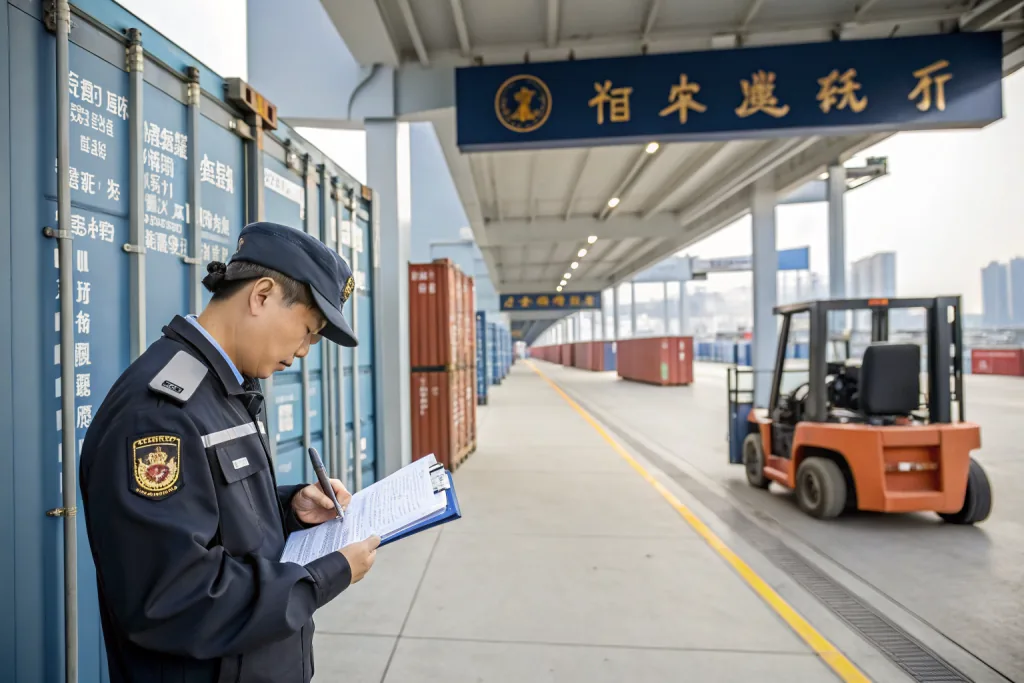
China import customs clearance is a systematic process where your shipment passes through Chinese export inspections and US import inspections, typically taking 5-14 days total depending on documentation and product category. Understanding this process helps you avoid costly delays, unexpected tariffs, and shipment holds that can derail your supply chain and damage your profit margins.
As a small or medium-sized business importing from China, you’ll encounter customs procedures on both the origin (China) and destination (US/Europe) sides. Each step has specific documentation requirements, fees, and timelines that directly impact your landed costs and delivery schedules. This guide walks you through the entire process with real numbers, timelines, and actionable steps.
What is the process of customs clearance in China?
China’s customs clearance process involves export inspections by Chinese authorities, documentation verification, and regulatory compliance checks before your shipment leaves Chinese ports or airports. The complete process typically unfolds in 2-5 business days within China, though it can extend to 7-10 days for high-risk product categories or incomplete documentation.
The Chinese customs clearance sequence includes:
- Pre-clearance documentation preparation: Your supplier or freight forwarder submits the commercial invoice, packing list, bill of lading, and export license (if required) to Chinese Customs 24 hours before shipment departure.
- Electronic Data Interchange (EDI) filing: Customs brokers file your shipment information into the CEBP (China Electronic Port) system, which cross-references against restricted goods lists and regulatory databases.
- Physical inspection (if flagged): Approximately 5-8% of shipments receive random or targeted inspections at the warehouse or port. Inspections typically take 1-3 days and may cost 500-1,500 RMB ($70-210 USD) if your shipment is selected.
- Duty and tax calculation: Chinese authorities calculate export duties (rare for most product categories—typically 0%) and value-added tax (VAT) at 13% for most goods, though your supplier usually bears this cost pre-export.
- Clearance release: Once approved, Chinese Customs issues an “export permit” and the shipment is released to the port or airport for loading onto the international carrier.
For most standard manufacturing goods (electronics, textiles, machinery parts, furniture), the process is routine and rarely delayed beyond 3-4 business days. However, products in restricted categories—batteries, chemicals, certain electronics—may trigger additional inspections from the China Entry-Exit Inspection and Quarantine (CEIQ) bureau, adding 2-5 extra days.
When working with an experienced China sourcing agent like Mangors Sourcing, your supplier and freight forwarder coordinate all documentation pre-shipment, reducing inspection likelihood and ensuring rapid clearance. We help vet suppliers who maintain proper export compliance records, which significantly speeds up the Chinese side of customs.
How long do US customs take to clear packages from China?
US customs typically clears packages from China in 2-7 business days after arrival at a US port of entry, though the timeline varies significantly based on cargo volume, product category, and documentation accuracy. During peak seasons (September-October), clearance can extend to 10-14 days.
Here’s the realistic timeline breakdown for a standard containerized shipment:
| Stage | Timeline | Key Factors |
|---|---|---|
| Port arrival to cargo release | 2-4 business days | Port congestion, entry inspection queue, documentation completeness |
| Entry filing and duty assessment | 1-2 business days | Accuracy of commercial invoice, HS code classification, tariff rate certainty |
| Physical examination (if selected) | 1-3 days (5-10% of shipments) | Product category, perceived compliance risk, random selection |
| Release to warehouse or delivery | Same day as clearance approval | Warehouse availability, drayage scheduling |
| Total typical clearance | 3-7 business days | Standard goods, accurate documentation, off-peak season |
For air freight shipments (used for high-value or time-sensitive goods), clearance is typically faster—usually 1-3 business days—because CBP (US Customs and Border Protection) prioritizes air cargo and documentation is often prepared in advance. However, air freight costs 8-15 times more than ocean freight, averaging $6-12 per kilogram versus $0.80-1.20 per kilogram for sea shipping.
Documentation accuracy is the single largest determinant of clearance speed. Misclassified HS codes, undervalued invoices, or missing certifications trigger “holds” that extend clearance by 5-10 additional days. For example, a shipment of lithium batteries with incomplete Safety Data Sheets will be held until documentation is corrected, potentially costing your business $500-2,000 in storage fees plus delayed inventory.
How do you clear customs in China?
To clear customs in China, your supplier and freight forwarder must submit complete export documentation, ensure proper HS code classification, and coordinate with Chinese Customs brokers at least 24 hours before shipment departure from the warehouse.
Here’s the step-by-step process:
Step 1: Prepare Export Documentation (3-5 days before shipment)
Your supplier must compile:
- Commercial Invoice: Detailed product descriptions, unit prices, quantities, total declared value (must match actual cost to avoid undervaluation penalties)
- Packing List: Itemized breakdown by box/container showing weight and dimensions
- Bill of Lading (B/L): Issued by the freight forwarder or shipping line; required for ocean freight
- Airway Bill (AWB): For air freight shipments
- Certificate of Origin: For products claiming preferential tariff treatment (not typically required for China exports)
- Product certifications: Quality certificates, test reports (especially for electronics, textiles, chemicals)
Common documentation errors that trigger delays include:
- Mismatched quantities between invoice, packing list, and B/L (adds 2-3 days for correction)
- Vague product descriptions like “assorted parts” instead of specific item names (requires clarification from exporter)
- Undervalued invoices flagged by Customs risk algorithms (leads to withholding pending valuation verification)
Step 2: File with Chinese Customs Broker (24 hours before loading)
Your freight forwarder submits the documentation package to a licensed Chinese Customs broker, who enters the data into the CEBP system. This filing includes:
- Exporter registration number and VAT certificate
- Importer details (your US company information)
- Detailed product code classification (HS code)
- Declared value in USD
- Port of export and port of entry (e.g., Shanghai to Los Angeles)
Filing fees typically range from 300-600 RMB ($42-85 USD) per shipment, depending on complexity and broker rates.
Step 3: Await Customs Risk Assessment
Chinese Customs runs your shipment through automated risk-assessment systems. Most shipments receive “green channel” (绿色通道) status, meaning automatic release without inspection. Approximately 8-12% receive “yellow channel” status, triggering physical inspection, and fewer than 2% receive “red channel” status, which means detailed examination and possible penalties for non-compliance.
Risk factors that trigger inspection include:
- First-time exporter status
- High-value shipments (>$50,000 USD)
- Product categories flagged as restricted (batteries, chemicals, certain electronics)
- Previous compliance violations on record
Step 4: Physical Inspection (if selected)
If your shipment is selected for inspection, Customs officers will examine samples from the containers to verify:
- Quantity matches the declared packing list
- Product quality and condition
- Proper labeling and markings
- Absence of prohibited or restricted items
Inspections cost 500-1,500 RMB ($70-210 USD) and typically take 1-3 days. Some suppliers negotiate fixed inspection fees with their logistics providers to ensure consistent costs.
Step 5: Receive Export Clearance and Release
Once cleared, Chinese Customs issues an electronic “export permit” (出口证) and the shipment is released for loading onto the vessel or aircraft. Your freight forwarder will notify you of release, and the shipment departs within 24-48 hours.
Key Costs and Timelines Summary
| Cost/Timeline Item | Amount/Duration | Notes |
|---|---|---|
| Chinese Customs broker fee | $42-85 USD | Per shipment; varies by port and complexity |
| Physical inspection fee (if selected) | $70-210 USD | Covers 8-12% of shipments; not guaranteed |
| China export clearance timeline | 2-5 business days | Routine shipments; can extend to 7-10 for restricted goods |
| US import tariff (average) | 5-15% of declared value | Varies by HS code; electronics typically 5-10%, textiles 15-25% |
| US customs brokerage fee | $75-150 USD | Per entry; may increase for complex shipments |
| US customs clearance timeline | 2-7 business days | Can extend to 10-14 days during peak seasons or if examination required |
| Port drayage (container pickup) | $200-400 USD | Cost to move container from port to warehouse |
Best Practices for Smooth Customs Clearance
Accurate HS code classification is critical—misclassification can result in tariff recalculations, penalties of up to 20% of the declared value, and shipment holds. When you’re unsure about the correct HS code, request a binding ruling from US Customs before importing (the ruling takes 30-60 days but protects you long-term).
Over-declare product values slightly to avoid undervaluation penalties. Chinese and US Customs use algorithms to flag invoices that are suspiciously low compared to market prices. A $15 widget invoiced at $8 raises red flags; invoiced at $12 passes scrutiny.
Provide complete product certifications upfront, especially for electronics (FCC), textiles (country-of-origin marking), and safety-sensitive items (test reports). Missing certifications trigger holds that cost $500-2,000 in storage fees per week.
Use a reliable freight forwarder with customs expertise. Your forwarder should have relationships with customs brokers at both origin (China) and destination (US) ports. This coordination cuts delays significantly.
How Mangors Sourcing Simplifies Customs Clearance
As an experienced China sourcing agent, Mangors Sourcing manages the entire customs clearance process for small and medium businesses importing from China. Our full-service support includes:
- Supplier vetting: We vet manufacturers for export compliance, ensuring they maintain proper documentation and regulatory certifications.
- Quality control inspections: Pre-shipment inspections reduce the likelihood of US Customs rejections and holds.
- Documentation coordination: We ensure invoices, packing lists, and certifications are complete and accurate before shipping.
- Customs brokerage coordination: We work with licensed brokers on both the China and US sides to expedite clearance.
- Tariff optimization: We help classify products correctly and identify duty-saving opportunities.
With Mangors Sourcing managing your supply chain, you avoid the common mistakes that delay shipments—incomplete documentation, supplier miscommunication, and misclassified HS codes. Our clients typically clear customs 1-2 days faster than businesses managing imports independently.
Ready to streamline your China imports? Contact Mangors Sourcing today for a free consultation. We’ll review your product category, estimated shipment volumes, and target suppliers to create a customs-optimized import strategy tailored to your business. Let’s eliminate delays and keep your supply chain moving efficiently.