
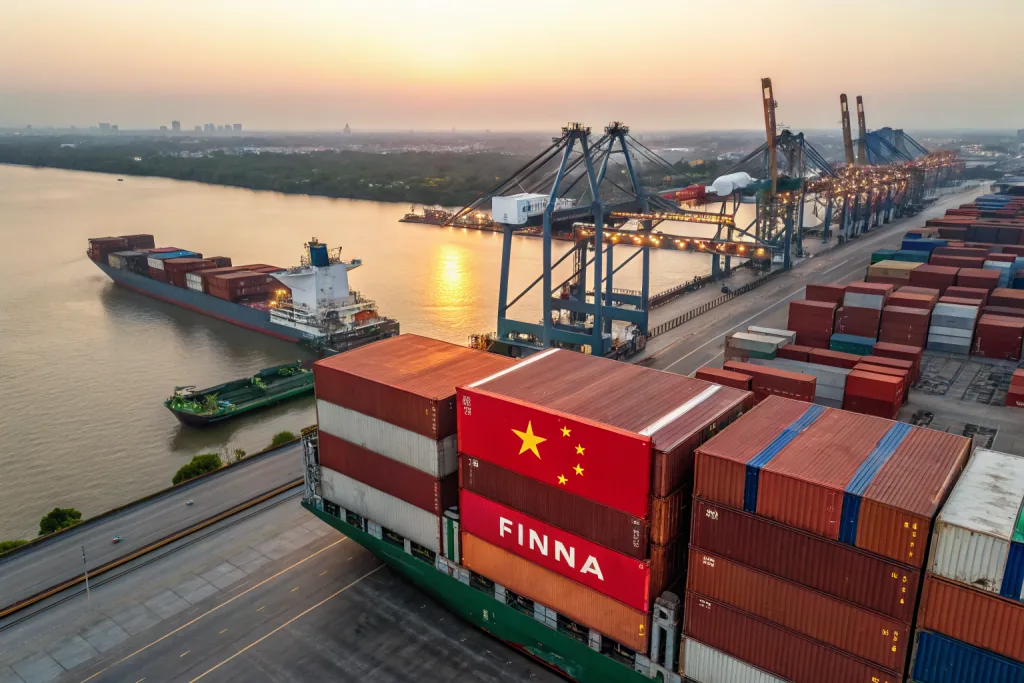
The most effective way to manage China supply chain risk is to diversify sourcing across 2-3 countries while maintaining China as your primary manufacturing base, reducing dependency exposure from 100% to 40-50% per region. This hybrid approach protects margins—keeping production costs 15-30% lower than alternatives—while building resilience against tariffs, port congestion, and geopolitical disruptions.
What is the China+1 Supply Chain Diversification Strategy?
The China+1 strategy means keeping your core manufacturing in China while establishing secondary production in one alternative country, typically Vietnam, India, Mexico, or Thailand.
This isn’t about abandoning China—it’s about risk distribution. China still offers unmatched manufacturing depth: 28% of global manufacturing output, 70,000+ electronic component suppliers in Shenzhen alone, and average MOQs 40% lower than Southeast Asian alternatives.
The +1 country handles 20-40% of volume, typically:
- Vietnam: Electronics, textiles, furniture (labor costs $3.50/hour vs. China’s $6.50)
- India: Pharmaceuticals, automotive parts, textiles
- Mexico: US-market goods (zero tariffs under USMCA, 3-day shipping vs. 25-35 days from China)
- Thailand: Automotive, food processing, medical devices
Implementation costs vary: setting up Vietnam operations runs $15,000-$50,000 in initial supplier development, while Mexico nearshoring requires $25,000-$75,000 but saves $3,000-$8,000 per container in shipping.
What Items Will Have Shortages from China?
Critical shortage risks in 2024-2025 concentrate in rare earth minerals (90% processed in China), semiconductors, lithium batteries, and specialized chemicals used in pharmaceuticals and agriculture.
Specific vulnerability categories:
| Product Category | China Global Share | Lead Time Extension Risk | Alternative Lead Time |
|---|---|---|---|
| Rare earth magnets | 87% | +45-90 days | 180+ days (US/Japan) |
| Lithium battery cells | 65% | +30-60 days | 90-120 days (S. Korea) |
| Active pharmaceutical ingredients (APIs) | 40% | +60-120 days | 150+ days (India) |
| Semiconductor packaging | 38% | +90+ days | 200+ days (Taiwan/Malaysia) |
| Solar panels (polysilicon) | 80% | +30-45 days | 120 days (SE Asia) |
Tariff exposure compounds shortage risk. Current US Section 301 tariffs hit 25% on $370B of Chinese goods, with proposed increases to 100% on EVs, 50% on solar cells, and 25% on batteries and critical minerals.
Mangors Sourcing recommends 90-day safety stock for any component where China concentration exceeds 60% and alternative sourcing requires 6+ months to qualify.
What Are the 7 C’s of SCM?
The 7 C’s of Supply Chain Management provide a framework for building resilient, diversified operations: Connectivity, Cybersecurity, Collaboration, Continuity, Cost, Carbon, and Compliance.
Here’s how each applies to China diversification:
- Connectivity: Real-time visibility across China + alternative suppliers. Investment: $5,000-$15,000 for ERP integration with Tier-2 suppliers.
- Cybersecurity: Protecting IP when sharing designs with multiple countries. China IP theft costs US businesses $225B-$600B annually; diversify to reduce single-point exposure.
- Collaboration: Strategic partnerships, not transactional relationships. Mangors Sourcing maintains 3-5 qualified suppliers per product category across regions.
- Continuity: Business continuity planning with 60-90 day alternative sourcing activation timelines.
- Cost: Total landed cost analysis. Vietnam manufacturing runs 10-15% higher than China, but tariff savings on affected goods often justify the premium.
- Carbon: Scope 3 emissions tracking. Mexico-to-US shipping generates 70% less CO2 than China-to-US air freight.
- Compliance: Uyghur Forced Labor Prevention Act (UFLPA) enforcement, REACH, Prop 65. Non-compliance penalties now exceed $500,000 for shipments detained at US ports.
Step-by-Step Diversification Implementation
Phase 1: Risk Assessment (Weeks 1-4)
Map your China dependency: categorize suppliers by concentration risk, lead time criticality, and switching costs. Target products where China represents 80%+ of supply for immediate diversification.
Phase 2: Alternative Supplier Development (Weeks 5-16)
Qualify 2-3 suppliers in your +1 country. Budget $12,000-$35,000 including:
- Factory audits: $800-$2,500 per facility
- Sample development: $500-$5,000
- First article inspection: $1,500-$4,000
- Production trial runs: 500-2,000 units at 15-25% premium
Phase 3: Parallel Production (Weeks 17-32)
Run 20-30% of volume through +1 supplier while maintaining China capacity. Expect 8-12 week quality convergence period.
Phase 4: Optimization (Ongoing)
Balance load based on total landed cost including tariffs, financing, and risk weighting. Many Mangors Sourcing clients settle on 60% China / 40% alternative splits after 18 months.
Cost Comparison: China vs. Alternative Sourcing
| Cost Factor | China | Vietnam | Mexico | India |
|---|---|---|---|---|
| Manufacturing labor (hourly) | $6.50 | $3.50 | $4.50 | $2.80 |
| Sea freight to US West Coast (40′ container) | $2,500-$4,500 | $3,200-$5,500 | $1,200-$2,000 (truck) | $3,800-$6,500 |
| Transit time to US | 14-25 days | 18-28 days | 3-7 days | 22-35 days |
| Tariff exposure (average) | 19.3% | 8.5% | 0% (USMCA) | 4.2% |
| MOQ (typical) | 500-1,000 units | 1,000-2,000 units | 800-1,500 units | 1,500-3,000 units |
| Supplier development timeline | 4-8 weeks | 10-16 weeks | 8-14 weeks | 12-20 weeks |
When to Start Your Diversification
Immediate action is warranted if: your China concentration exceeds 70%, you import goods on the Section 301 tariff list, or your customers require supply chain transparency ratings. Companies that diversified in 2019-2020 maintained 94% on-time delivery during 2021-2022 port congestion; China-dependent competitors saw 35-60% delays.
The cost of inaction is rising. 2024 freight rates from China have increased 55% year-over-year due to Red Sea diversions, and the US is reviewing additional tariffs on $18B of Chinese goods including EVs, batteries, and solar products.
Mangors Sourcing helps small and medium businesses navigate this complexity with full-service support: supplier vetting across China and alternative markets, quality control at production and pre-shipment, freight forwarding and customs clearance, and ongoing supplier relationship management. Our clients reduce supply chain risk exposure by an average of 40% within 12 months of engagement.
Ready to protect your supply chain? Contact Mangors Sourcing for a free consultation. We’ll analyze your current China exposure, identify your optimal +1 market, and provide a roadmap with specific timelines and investment requirements for your product categories.