
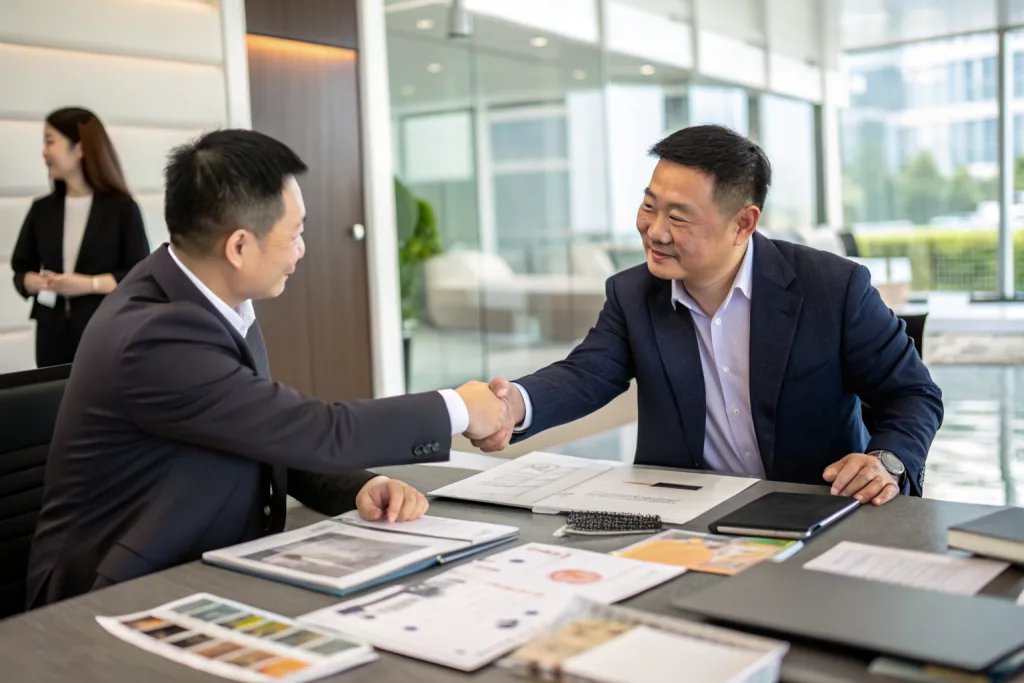
A China sourcing agent is a professional intermediary who helps businesses find, evaluate, and purchase products from Chinese manufacturers and suppliers on behalf of international buyers. These agents act as your boots on the ground in China, handling everything from supplier identification and price negotiation to quality control and shipping logistics, typically charging 5-10% of the order value or a flat monthly retainer.
For small and medium businesses looking to import from China, working with an experienced sourcing agent can save thousands of dollars in mistakes, reduce lead times by 30-40%, and provide access to suppliers that don’t appear on Alibaba or Global Sources. This guide explains everything you need to know about China sourcing agents in 2026.
How Does a China Sourcing Agent Work?
A China sourcing agent works by representing your business interests throughout the entire procurement process in China, from initial supplier research to final product delivery at your warehouse. They leverage their local presence, language skills, industry connections, and knowledge of Chinese business practices to negotiate better prices, ensure quality standards, and navigate the complexities of international trade.
The typical workflow involves several key stages. First, you provide your product specifications, target price points, and quality requirements. The agent then identifies 5-10 potential suppliers, conducts factory audits, requests samples, and presents you with vetted options complete with pricing comparisons. Once you select a supplier, the agent negotiates terms, manages production timelines, conducts pre-shipment inspections, arranges logistics, and handles customs documentation.
What Services Do China Sourcing Agents Provide?
China sourcing agents provide comprehensive services covering the entire supply chain, including supplier identification, factory audits, price negotiation, sample procurement, quality control inspections, production monitoring, shipping coordination, and customs clearance assistance.
Here’s a detailed breakdown of core services:
- Supplier Sourcing & Vetting: Identifying manufacturers that match your specifications, verifying business licenses, checking production capacity (typical minimum 500-1000 units monthly), and assessing financial stability
- Price Negotiation: Leveraging local knowledge to secure 10-25% better pricing than direct contact, understanding regional cost structures, and negotiating payment terms
- Quality Control: Conducting pre-production inspections, during-production monitoring (DUPRO), and pre-shipment inspections (PSI) following ANSI/ASQC Z1.4 standards
- Sample Management: Ordering samples from multiple suppliers, coordinating modifications, managing sample shipping (typically $30-80 via DHL/FedEx)
- Production Oversight: Monitoring manufacturing timelines, ensuring adherence to specifications, troubleshooting production issues
- Logistics Coordination: Arranging sea freight ($1,500-4,500 per 40ft container) or air freight ($4-8/kg), managing documentation, coordinating with freight forwarders
- Customs & Compliance: Preparing commercial invoices, packing lists, certificates of origin, and ensuring compliance with destination country regulations
Mangors Sourcing, as an experienced China sourcing agent, provides all these services with a particular focus on helping small and medium businesses navigate their first imports or scale existing operations efficiently.
How Much Does a China Sourcing Agent Cost?
China sourcing agents typically charge 5-10% commission on the total order value, with rates varying based on order complexity, product category, and service scope, though some agents offer flat monthly retainers ranging from $1,500 to $5,000 for ongoing partnerships.
Here’s a detailed pricing comparison:
| Pricing Model | Typical Rate | Best For | Example Cost |
|---|---|---|---|
| Commission-Based | 5-10% of order value | One-off orders, new importers | $500 on $10,000 order (5%) |
| Monthly Retainer | $1,500-5,000/month | Regular importers, multiple SKUs | $2,500/month for 10+ orders |
| Hybrid Model | 2-3% + reduced retainer | Growing businesses | $1,000 retainer + 3% commission |
| Per-Project Fee | $800-3,000 per project | Product development, sampling | $1,200 for supplier search + samples |
Additional costs to consider include quality inspections ($200-350 per inspection), sample fees ($50-300 per supplier), and translation services if needed. However, experienced agents typically save clients 15-30% on product costs through better negotiation, which often exceeds their commission fees.
What’s the Difference Between a Sourcing Agent and a Trading Company?
A sourcing agent works exclusively for the buyer and charges transparent service fees while connecting you directly with manufacturers, whereas a trading company acts as a middleman who purchases products from factories and resells them to you at marked-up prices (typically 15-40% above factory cost) without full transparency.
Key distinctions include:
- Loyalty & Transparency: Agents represent your interests and disclose all costs; trading companies prioritize their profit margins
- Pricing Structure: Agents charge visible fees (5-10%); trading companies embed hidden markups in product prices
- Factory Relationships: Agents connect you directly to manufacturers for long-term relationships; trading companies keep supplier information confidential
- Flexibility: Agents can switch suppliers if issues arise; trading companies limit you to their network
- MOQ Requirements: Agents negotiate lower MOQs (often 200-500 units); trading companies typically require higher quantities (1000+ units)
When Should You Use a China Sourcing Agent?
You should use a China sourcing agent when you lack the time, language skills, or local expertise to effectively manage Chinese suppliers yourself, particularly for first-time imports, complex products requiring technical specifications, orders exceeding $5,000, or when quality control is critical to your brand reputation.
Specific scenarios where agents provide maximum value:
- First-Time Importing: When you’re unfamiliar with Chinese business practices, payment terms (typically 30% deposit, 70% before shipment), or Incoterms (FOB, CIF, DDP)
- Custom Product Development: Products requiring mold creation ($1,500-15,000), prototyping, or technical specifications beyond standard offerings
- Quality-Critical Products: Items where defects could damage your brand or cause safety issues (electronics, children’s products, food contact items)
- Multiple Supplier Management: When sourcing 5+ different products from various regions (Guangdong for electronics, Zhejiang for textiles, Jiangsu for furniture)
- Time-Sensitive Projects: Compressed timelines requiring someone on-ground to expedite production (standard lead times: 15-30 days production + 25-35 days sea freight)
- Scaling Operations: Moving from small test orders (500-1000 units) to larger production runs (5,000+ units) requiring tighter quality control
How to Choose the Right China Sourcing Agent?
Choose a China sourcing agent by evaluating their industry specialization, physical presence in manufacturing regions, transparent pricing structure, quality control processes, client references, and communication responsiveness, prioritizing agents with at least 5 years of experience and existing relationships in your product category.
Essential evaluation criteria:
- Industry Expertise: Verify experience in your product category (electronics, textiles, home goods, etc.) with specific supplier networks in relevant manufacturing hubs
- Physical Infrastructure: Confirm offices near major manufacturing centers (Shenzhen, Guangzhou, Ningbo, Shanghai, Yiwu) with employed QC inspectors, not just freelancers
- Quality Control Capabilities: Ask about inspection protocols, whether they follow AQL standards, photo/video documentation processes, and defect rate tracking
- Communication Standards: Test response times (should reply within 24 hours), English proficiency, and reporting detail during initial consultations
- Transparent Pricing: Request clear fee structures upfront with no hidden charges; avoid agents who are vague about commission rates
- Verifiable References: Contact 2-3 current clients in similar industries; ask about problem resolution, cost savings achieved, and defect rates
- Technology & Systems: Evaluate their project management tools, order tracking systems, and documentation processes
What Are Common Mistakes When Working with Sourcing Agents?
The most common mistakes when working with sourcing agents include failing to establish clear product specifications upfront, not defining quality standards with measurable criteria, choosing agents based solely on the lowest commission rates, and neglecting to verify the agent’s independence from suppliers.
Critical mistakes to avoid:
- Vague Product Specifications: Providing unclear requirements leads to unsuitable supplier matches; always include dimensions, materials, tolerances, certifications needed (CE, FCC, FDA), and quality expectations
- Skipping Sample Stage: Proceeding to production without approving samples causes 60-70% of quality disputes; always order samples from 3-5 suppliers
- No Written Agreements: Operating without contracts defining scope, payment terms, liability, and quality standards leaves both parties vulnerable
- Ignoring Red Flags: Agents pressuring quick decisions, refusing factory visits, being vague about supplier locations, or offering unrealistically low prices (20%+ below market)
- Poor Payment Practices: Paying 100% upfront without production milestones eliminates leverage; standard terms are 30/70 or 30/60/10
- Inadequate Quality Checks: Relying solely on supplier QC without independent third-party inspections results in 30-40% higher defect rates
Can Small Businesses Afford China Sourcing Agents?
Yes, small businesses can afford China sourcing agents because the 5-10% service fee is typically offset by 15-30% savings on product costs through better negotiation, reduced defect rates (saving 5-15% in replacements), and avoiding costly mistakes that plague first-time importers, with breakeven occurring on orders as small as $3,000-5,000.
The financial case for small businesses:
| Scenario | DIY Approach | With Sourcing Agent | Net Difference |
|---|---|---|---|
| Product Cost (1000 units) | $8,000 | $6,500 (19% savings) | -$1,500 |
| Defect Rate Impact | $800 (10% defects) | $195 (3% defects) | -$605 |
| Agent Fee (7%) | $0 | $455 | +$455 |
| Shipping (optimized routing) | $1,200 | $1,050 | -$150 |
| Total Savings | – | – | $1,800 |
Beyond direct cost savings, agents save small businesses 40-60 hours per order on supplier communication, problem-solving, and logistics coordination—time better spent on marketing and sales.
What Questions Should You Ask a Potential Sourcing Agent?
You should ask potential sourcing agents about their specific experience in your product category, physical office locations and QC team size, fee structure and payment terms, quality control procedures and AQL standards used, average client retention rate, and whether they receive any commissions from suppliers.
Critical questions for your consultation:
- “How many clients in [your industry] have you worked with in the past 2 years, and can you provide references?”
- “What manufacturing regions do you have physical presence in, and how many full-time QC inspectors do you employ?”
- “Walk me through your exact quality control process from pre-production to pre-shipment inspection.”
- “What is your complete fee structure, including any additional charges for inspections, samples, or rush services?”
- “Do you receive any commissions or rebates from factories, and how do you ensure pricing transparency?”
- “What is your typical client retention rate, and what percentage of your clients place repeat orders?”
- “How do you handle quality issues or production delays, and what recourse do I have if problems arise?”
- “What is your average response time for emails and urgent issues during Chinese business hours?”
- “Can you provide examples of cost savings you’ve achieved for similar clients in the past 12 months?”
- “What certifications or compliance documentation can you help secure (CE, FDA, FCC, etc.), and at what cost?”
How Long Does the Sourcing Process Take with an Agent?
The complete sourcing process with a China agent typically takes 45-75 days from initial consultation to product delivery, broken down into supplier identification (7-10 days), sampling (10-15 days including shipping), negotiation and order placement (3-5 days), production (15-30 days depending on product complexity), and shipping (25-35 days for sea freight or 5-7 days for air freight).
Detailed timeline for a typical order:
- Week 1-2: Requirement discussion, supplier research, initial factory shortlist of 5-8 candidates
- Week 2-4: Sample ordering from 3-5 suppliers, sample production (5-7 days), international shipping (5-7 days via express courier)
- Week 4-5: Sample evaluation, supplier selection, price negotiation, payment term finalization, purchase order issuance
- Week 5-9: Production period (varies: simple products 15-20 days, complex products 25-30 days), with DUPRO inspection at 50-70% completion
- Week 9-10: Pre-shipment inspection, packaging verification, booking freight (2-3 days lead time for container availability)
- Week 10-15: Sea freight transit (25-35 days China to US West Coast, 35-40 days to East Coast, 28-35 days to Europe), customs clearance (2-5 days)
For urgent orders, air freight reduces shipping to 5-7 days but costs $4-8 per kilogram versus $0.50-1.50 per kilogram for sea freight, making it economical only for small, high-value shipments under 200kg.
Ready to Start Sourcing from China with Confidence?
Working with an experienced China sourcing agent eliminates the guesswork, reduces costly mistakes, and gives small and medium businesses access to the same supplier networks and negotiating power as large importers. Whether you’re placing your first order or scaling existing operations, professional sourcing support delivers measurable ROI through better pricing, higher quality, and faster timelines.
Mangors Sourcing specializes in helping small and medium businesses import from China with full-service support including supplier vetting, factory audits, quality control inspections, shipping coordination, and customs assistance. Our team maintains physical presence in major manufacturing hubs with experienced QC inspectors and long-standing factory relationships across electronics, home goods, textiles, and consumer products.
Contact Mangors Sourcing today for a free consultation to discuss your product requirements, get transparent pricing, and learn how we can help you source high-quality products from China while avoiding the common pitfalls that cost first-time importers thousands of dollars. Let us handle the complexity of China sourcing while you focus on growing your business.