
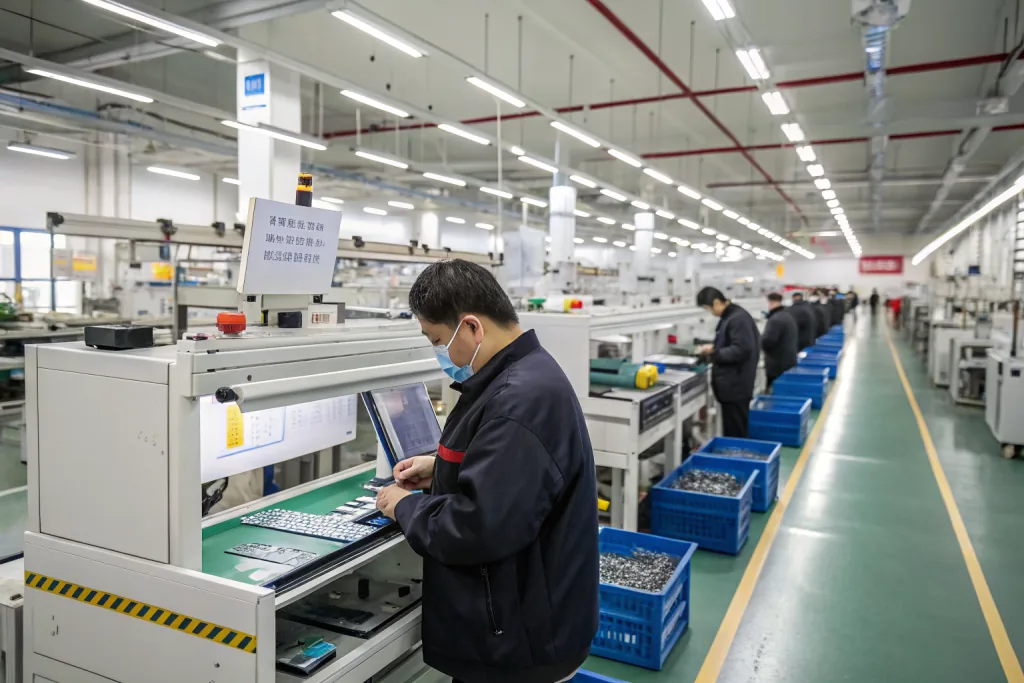
OEM manufacturing in China allows businesses to hire Chinese factories to produce branded products designed by the buyer, with the manufacturer handling production and quality control under the buyer’s specifications. This approach offers significant cost savings—typically 30-50% lower than domestic manufacturing—and access to advanced production capabilities, making it the preferred sourcing method for thousands of small and medium-sized businesses worldwide.
What is OEM in China?
OEM (Original Equipment Manufacturing) in China means contracting with a Chinese factory to manufacture products according to your exact specifications, designs, and quality standards, with your brand name on the final product.
When you choose OEM manufacturing in China, you provide the factory with detailed product specifications, samples, technical drawings, and branding requirements. The manufacturer then produces the goods using their facilities, equipment, and labor, while you retain full ownership of the design and brand. This differs significantly from simply buying wholesale products—you control the entire product development and production process.
Here’s what makes OEM manufacturing attractive for importers:
- Cost advantage: Chinese labor costs are 60-70% lower than US rates, translating to unit prices that range from 30-50% cheaper than domestic production
- Scalability: Factories can produce anywhere from 500 units to 50,000+ units per order
- Technical expertise: Chinese manufacturers specialize in electronics, textiles, machinery, consumer goods, and nearly every product category
- Full customization: You control materials, colors, packaging, labeling, and product features
- Speed to market: Average production lead times range from 4-8 weeks, compared to 12-16 weeks for equivalent domestic manufacturing
A practical example: A US brand importing 5,000 plastic storage containers might pay $2.50-$3.00 per unit from a Chinese OEM, compared to $4.50-$5.50 if manufactured domestically. At this volume, the total savings would be $10,000-$12,500 per order.
Which is Better, OEM or ODM?
OEM is better if you have a specific product design and want full control over specifications, while ODM (Original Design Manufacturing) is better if you want the manufacturer to design the product for you and simply rebrand it.
The key difference comes down to design ownership and customization:
| Factor | OEM Manufacturing | ODM Manufacturing |
|---|---|---|
| Design Responsibility | You provide the design and specifications | Manufacturer designs the product |
| Customization Level | 100% custom—you control every detail | Limited—based on manufacturer’s existing designs |
| Time to Production | 4-8 weeks (after design finalization) | 2-4 weeks (using existing molds/designs) |
| Product Cost | Higher upfront (tooling/molds required) | Lower (manufacturer reuses existing tooling) |
| Minimum Order Quantity | Typically 1,000-5,000 units | Can be as low as 100-500 units |
| Intellectual Property | You own the design; manufacturer cannot resell | Manufacturer may sell similar designs to competitors |
| Best For | Established brands with unique products | New sellers testing markets with minimal investment |
Choose OEM if: You have a proprietary product design, want complete differentiation from competitors, or are scaling an established product line. E-commerce brands, consumer goods companies, and niche product creators typically use OEM.
Choose ODM if: You’re new to importing, want faster time-to-market, have a limited budget for tooling and molds, or want to test product viability before committing significant capital. Many Amazon sellers start with ODM to validate demand, then transition to OEM for custom variations.
A real-world example: A startup importing Bluetooth speakers might use ODM first, purchasing white-label speakers from a manufacturer’s existing design at $8-$12 per unit with a 500-unit MOQ. Once they validate market demand and have 10,000 units ordered, they switch to OEM to create a custom design with unique speaker grilles, colors, and packaging, paying $6-$8 per unit but investing $3,000-$5,000 in mold tooling.
What is the Best Website to Find Chinese Manufacturers?
The best single website to find Chinese manufacturers is Alibaba.com, which lists over 10 million suppliers, though you should verify manufacturer credibility through multiple channels and work with an experienced sourcing agent for vetting.
Here are the top platforms and resources for locating Chinese OEM manufacturers:
- Alibaba.com – The largest B2B marketplace with suppliers across all product categories. Search by product type, filter by “OEM available,” and review supplier certifications (Gold Supplier status, trade assurance, years in business). Expect 50-500+ results per product search.
- Global Sources – A vetted supplier directory covering electronics, home goods, toys, and machinery. Suppliers undergo verification before listing, making quality generally higher than Alibaba, though pricing tends to be 10-15% higher.
- Made-in-China.com – Another major portal with verified suppliers, particularly strong for industrial equipment, textiles, and chemicals.
- Thomasnet/Global Trade Hub – Useful for industrial and machinery manufacturers, though fewer suppliers than Alibaba.
- Canton Fair (China Import and Export Fair) – Held twice yearly in Guangzhou; thousands of manufacturers exhibit in person. Spring Fair draws 180,000+ visitors and 24,000+ exhibitors.
- Direct factory relationships – Once you identify potential suppliers on platforms, request factory visits or request samples directly from their sales teams.
Important caution: Finding manufacturers online is the easy part; vetting them properly is where most importers struggle. Scams are common—fake certifications, quality misrepresentation, and non-delivery happen regularly. This is where working with a professional China sourcing agent like Mangors Sourcing becomes invaluable.
The OEM Manufacturing Process: Step-by-Step
The typical OEM manufacturing journey in China follows this timeline:
- Weeks 1-2: Supplier identification and initial contact – You find 5-10 potential manufacturers, send inquiries with product specifications and volume requirements, and request quotes and samples.
- Weeks 2-4: Sample evaluation and negotiation – Manufacturers send product samples (typically $20-$200 per sample, depending on product complexity). You evaluate quality, provide feedback, negotiate pricing, and discuss MOQ and payment terms.
- Weeks 4-6: Tooling and mold creation – For products requiring custom molds (injection-molded plastics, metal parts, etc.), you pay tooling fees ranging from $500-$10,000+. This process takes 2-4 weeks.
- Weeks 6-10: Production run – The factory manufactures your full order. Lead times typically range from 3-6 weeks for most products.
- Week 10: Quality inspection and shipping – A QC inspector examines finished goods (defect rates should be under 2-3% for acceptable quality). Products are packed and shipped, arriving in 15-35 days by sea freight or 5-10 days by air freight.
OEM Manufacturing Costs: Real Numbers
Here’s what you should budget for OEM manufacturing:
- Tooling and molds: $500-$5,000 for simple plastic molds; $5,000-$20,000+ for complex metal or precision tooling
- Unit production cost: 30-50% cheaper than US equivalent; expect $1-$15 per unit depending on product complexity
- Shipping (by sea): $2,000-$8,000 per container (20ft container holds 10,000-15,000 units of most goods); works out to $0.15-$0.50 per unit
- Shipping (by air): 4-6x more expensive but arrives in 5-10 days; used only for urgent orders
- Import tariffs (US): 0-25% depending on product category; most consumer goods face 5-15% tariffs
- Quality control inspection: $300-$800 per production run if outsourced to third-party inspectors
- Customs clearance and brokerage: $200-$500 per shipment
Total landed cost example: Importing 5,000 units of a consumer product might break down as:
- Manufacturing: 5,000 × $3.50 = $17,500
- Shipping: $4,500 (1/4 container)
- Tariffs (12%): $2,640
- QC inspection: $500
- Customs/brokerage: $350
- Total landed cost: $25,490 ($5.10 per unit)
Compare this to a domestic manufacturer charging $8-$10 per unit, and the China advantage becomes clear.
Working with a China Sourcing Agent
Managing OEM manufacturing independently requires expertise in supplier vetting, quality control, logistics, and Chinese business practices. Many first-time importers lose 10-30% of their investment due to quality issues, shipping delays, or working with unreliable suppliers.
This is where Mangors Sourcing helps. As an experienced China sourcing agent, we assist small and medium businesses in finding, vetting, and managing relationships with reliable Chinese OEM manufacturers. Our full-service approach includes:
- Supplier identification and background verification
- Negotiation of pricing and payment terms
- Quality control inspections before shipment
- Logistics coordination and customs clearance
- Ongoing relationship management and troubleshooting
Working with a sourcing agent typically costs 5-8% of your order value but saves far more through better pricing, fewer quality issues, and faster problem resolution.
Final Thoughts
OEM manufacturing in China offers substantial cost savings and access to production capabilities that can transform your business. The key is working with reliable manufacturers and understanding every step of the process—from design specifications through final delivery.
Ready to start your OEM manufacturing journey? Contact Mangors Sourcing today for a free consultation. Our team will help you identify the right manufacturers, negotiate competitive pricing, and ensure your products meet quality standards. Let’s discuss your sourcing needs and find the perfect manufacturing partner for your business.