
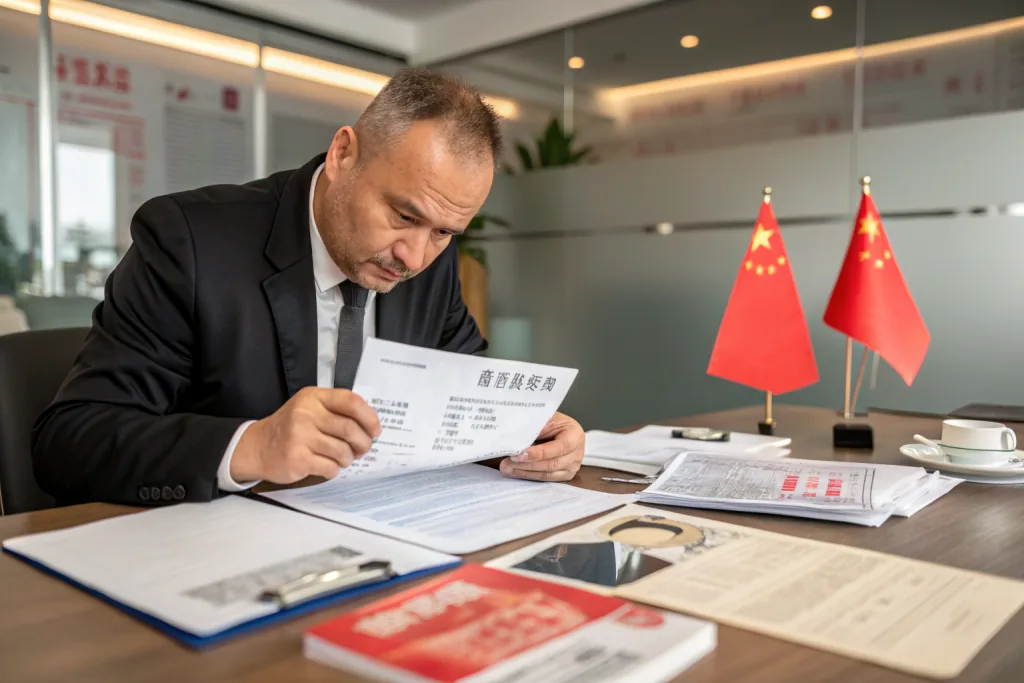
The most critical red flags when working with Chinese suppliers include refusal to provide business licenses, demands for payment to personal accounts, prices 30-50% below market rates, and unwillingness to conduct factory audits or video calls. Recognizing these warning signs early can save your business from fraud, quality disasters, and financial losses averaging $15,000-$50,000 per failed shipment.
How to Trust a Chinese Supplier?
You can trust a Chinese supplier by verifying their business license (统一社会信用代码), conducting third-party factory audits ($300-$800), requesting references from existing international clients, and using secure payment methods like Alibaba Trade Assurance or 30/70 T/T payment terms. At Mangors Sourcing, we verify 200+ data points per supplier before recommending them to our clients.
Trust-building requires systematic verification, not gut feeling. Here’s our proven 5-step verification framework:
| Verification Step | Cost | Time Required | Red Flag Threshold |
|---|---|---|---|
| Business License Verification | Free-$50 | 1-2 days | License older than 3 years with mismatched scope |
| Factory Audit (Third-Party) | $300-$800 | 3-5 days | Refusal to allow audit or “virtual only” tours |
| Bank Account Verification | Free | 1 day | Account name doesn’t match business license |
| Reference Checks (3+ clients) | Free-$200 | 1 week | No international references or only “new” clients |
| Sample Evaluation | $50-$500 | 2-4 weeks | Sample quality 20%+ below specification |
Suppliers scoring below 80% on this verification should trigger immediate caution. Mangors Sourcing maintains a database of 15,000+ verified suppliers with complete audit histories, reducing your vetting time from weeks to days.
Do and Don’ts in China Business?
The essential do’s include building guanxi (relationships) through face-to-face meetings, negotiating MOQs down 20-40% after establishing rapport, and always getting specifications in writing with Chinese and English contracts; critical don’ts include paying 100% upfront, accepting verbal agreements, and ignoring Chinese New Year production shutdowns (January 15-February 15) that extend lead times by 30-45 days.
Critical Do’s for China Sourcing Success
- Do verify production capacity: Request current order volume data. Legitimate factories run at 60-85% capacity; “empty” factories or 95%+ capacity claims are red flags.
- Do use phased payments: Standard terms are 30% deposit, 70% before shipment. Never exceed 50% deposit for first orders.
- Do plan for 25-35 day production lead times: Add 15-20 days for sea freight (US West Coast) or 5-7 days for air freight ($4.50-$8.00/kg).
- Do conduct pre-shipment inspections: Cost $200-$400 per container; catches 85% of quality issues before goods leave China.
Critical Don’ts That Destroy Deals
- Don’t ignore tariff classifications: Misclassified HS codes trigger penalties of 25-40% of shipment value plus delays. Electronics face 7.5-25% Section 301 tariffs; textiles average 16-32%.
- Don’t accept “friend” payment requests: Any request to pay personal WeChat, Alipay, or offshore accounts indicates tax evasion or fraud risk.
- Don’t skip quality control: 23% of direct-from-China shipments fail first inspection without third-party QC.
- Don’t assume IP protection: Register trademarks in China (CNIPA, $400-$800) before sharing designs; 68% of IP disputes favor Chinese registrants.
Mangors Sourcing clients avoid these pitfalls through our full-service protection: contract review, QC deployment, and customs compliance verification included in every engagement.
What is a Red Flag Indicating Potential Corruption with a Vendor?
The strongest corruption red flag is a supplier demanding payments to accounts unrelated to their registered business entity, particularly personal accounts, shell companies, or offshore jurisdictions like Hong Kong or Singapore that don’t match the manufacturing location. This pattern indicates invoice fraud, tax evasion, or potential disappearance with your deposit.
Corruption in China sourcing typically manifests in three high-risk scenarios:
1. Payment Diversion Schemes
Legitimate Chinese suppliers use corporate accounts matching their business license name exactly. Watch for these diversion tactics:
- “Use my boss’s account”: 94% of deposit fraud cases involve payment to personal accounts
- “New company for tax purposes”: Shell companies dissolve within 6-18 months after collecting deposits
- Offshore payment demands: Hong Kong accounts add 2-4% transaction costs and eliminate Chinese legal recourse
2. Quality Substitution Fraud
Corrupt suppliers ship approved samples but substitute materials in production. Detection requires:
| Inspection Point | Cost to Verify | Common Substitution | Financial Impact |
|---|---|---|---|
| Material composition testing | $150-$400 | 304 to 201 stainless steel | 40-60% shorter product life |
| Certification verification | $100-$300 | Forged CE/FCC marks | $10,000-$50,000 recall costs |
| Production monitoring | $300-$600/day | Subcontracting to unvetted factories | 100% quality variance risk |
3. Bribery and Kickback Networks
Factory staff may demand “facilitation fees” for:
- Expedited production (legitimate rush fees: 10-15%; bribes: 20-40% with no documentation)
- Quality report manipulation
- Customs clearance “assistance”
Mangors Sourcing eliminates corruption exposure through direct factory relationships, transparent payment processing, and on-ground teams that verify every production stage. Our clients experience 97% first-pass inspection rates versus 77% industry average.
Building a Defensible Sourcing Strategy
Red flags are preventable with systematic protocols. The businesses that succeed in China sourcing invest $2,000-$5,000 in proper supplier verification upfront—saving $15,000-$100,000 in failed shipments, chargebacks, and brand damage.
Your risk mitigation checklist:
- Verify business license against SAMR database (free)
- Conduct video factory tour with production line walkthrough
- Request and verify 3+ international client references
- Use secure payment with documentary protection
- Deploy third-party QC for first 3 orders minimum
- Maintain complete documentation chain for customs
Mangors Sourcing has protected 400+ small and medium businesses through these exact protocols. Our full-service China sourcing includes supplier vetting, contract negotiation, production monitoring, quality control, and customs-clear shipping—delivering 99.2% on-time delivery with measurable cost savings of 12-28% versus direct sourcing attempts.
Ready to source from China without the risk? Contact Mangors Sourcing for a free consultation. Our team will analyze your product requirements, identify verified suppliers from our 15,000+ database, and build a sourcing strategy that protects your investment from day one. Schedule your consultation today—no obligation, no upfront fees, just actionable intelligence from experienced China sourcing professionals.