
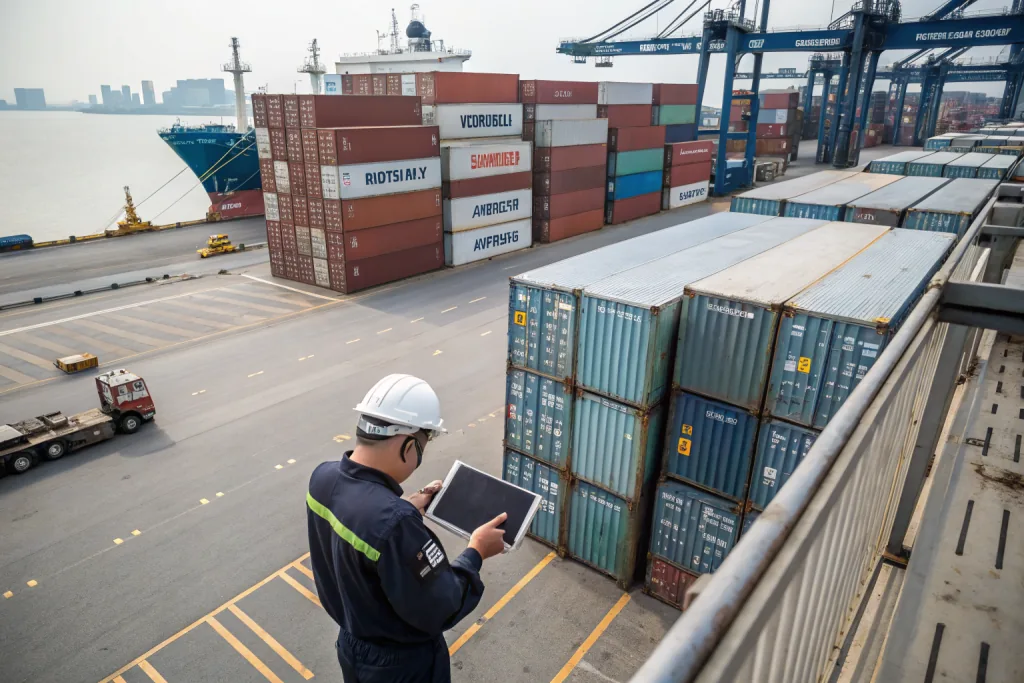
The ISF (Importer Security Filing) is a mandatory U.S. Customs requirement for ocean freight imports, commonly called “10+2” because it requires 10 data elements from the importer and 2 from the carrier, and it must be filed at least 24 hours before cargo is loaded onto a vessel bound for the United States.
Why is ISF called 10/2?
ISF is called “10+2” because it requires 10 data elements submitted by the importer or their agent, plus 2 data elements submitted by the ocean carrier.
The 10 elements from the importer cover the shipment details and parties involved:
| Element | Description | Example |
|---|---|---|
| 1. Manufacturer name/address | Actual factory producing goods | Zhejiang Textile Co., Ltd, Hangzhou |
| 2. Seller name/address | Party selling for export | Same as manufacturer or trading company |
| 3. Buyer name/address | US importer of record | Your company, Los Angeles, CA |
| 4. Ship-to name/address | Final delivery location | Your warehouse or 3PL |
| 5. Container stuffing location | Where container was loaded | Ningbo Port Container Yard |
| 6. Consolidator name/address | Party stuffing container | Freight forwarder warehouse |
| 7. Importer of record number | EIN, CBP assigned number, or SSN | XX-XXXXXXX |
| 8. Consignee number | Internal reference or EIN | Same as IOR or separate ID |
| 9. Country of origin | Where goods were manufactured | CN (China) |
| 10. HTSUS number | Harmonized Tariff Schedule code | 6203.42.11.00 (men’s cotton trousers) |
The 2 elements from the carrier are:
- Vessel stow plan – physical loading details of the container
- Container status messages – real-time tracking of container movements
As an experienced China sourcing agent, Mangors Sourcing handles ISF-10 filings for clients importing from China, ensuring all 10 elements are accurate and submitted on time to avoid penalties.
What is the difference between ISF-10, ISF-5, and ISF 5?
ISF-10 is the full filing required for standard imports, while ISF-5 is a simplified filing used only for foreign cargo remaining on board (FROB), transit cargo, or immediate exportation shipments that will not formally enter U.S. commerce.
| Feature | ISF-10 (Standard) | ISF-5 (Simplified) |
|---|---|---|
| Data elements required | 10 elements from importer | 5 elements from importer |
| Typical use case | Goods entering U.S. commerce | FROB, IE, T&E shipments |
| Manufacturer required | Yes | No |
| HTSUS number required | Yes (10 digits) | No |
| Country of origin required | Yes | No |
| Booking party required | Yes | Yes |
| Foreign port of lading | Yes | Yes |
| Place of delivery | Yes | Yes |
| Ship-to party | Yes | Yes |
| Commodity HTSUS (if applicable) | Yes | Yes |
| Penalty exposure | Up to $10,000 per violation | Up to $10,000 per violation |
Most small and medium businesses importing from China need ISF-10, not ISF-5. If your shipment is standard ocean freight destined for U.S. sale, ISF-10 applies. Mangors Sourcing verifies filing requirements during supplier vetting to prevent classification errors.
How far in advance does ISF need to be filed?
ISF must be filed at least 24 hours before cargo is loaded onto the vessel at the foreign port, not 24 hours before arrival in the U.S.
This timing distinction is critical. The “load date” is when containers are placed on the ship in China—typically Shanghai, Shenzhen, Ningbo, or Qingdao. For a vessel departing Shanghai on Friday, your ISF must be submitted by Thursday at minimum.
Recommended timeline for ISF compliance:
- 72+ hours before loading: Gather all 10 data elements from your China supplier
- 48 hours before loading: Submit ISF-10 to allow buffer for corrections
- 24 hours before loading: Hard deadline—CBP receives filing
- At loading: Carrier submits vessel stow plan and container status
- Upon arrival: Customs clearance proceeds with matched ISF data
Missing the 24-hour deadline exposes importers to:
- $5,000-$10,000 penalties per ISF violation
- Customs holds delaying cargo release
- Increased examination rates (physical inspections costing $300-$800)
- Refused boarding—cargo left at foreign port
ISF Filing Costs and Who Handles It
ISF filing costs range from $25-$150 when handled by a customs broker or freight forwarder, or $0 if you self-file through CBP’s ACE portal—though self-filing requires significant expertise.
Cost breakdown for typical China imports:
| Service | Cost Range | Best For |
|---|---|---|
| Self-filing via ACE | $0 (plus staff time) | High-volume importers with dedicated compliance staff |
| Freight forwarder ISF add-on | $25-$50 | Single service provider convenience |
| Customs broker filing | $75-$150 | Complex shipments requiring HTSUS expertise |
| Sourcing agent bundled service | Often $0-$75 | Full-service import management |
Mangors Sourcing includes ISF filing coordination in our full-service packages for small and medium businesses, typically at $0-$50 when bundled with supplier vetting, quality control, and shipping management. This eliminates the need to coordinate between separate brokers, forwarders, and suppliers.
Common ISF Mistakes When Importing from China
Data accuracy failures cause 60% of ISF penalties, according to industry estimates. Specific errors include:
- Manufacturer mismatches: Listing trading company instead of actual factory—CBP cross-references against shipment documents
- HTSUS errors: Using 4- or 6-digit codes instead of required 10 digits; incorrect classification triggers duty disputes
- Timing miscalculations: Confusing vessel arrival with loading date, especially with transshipment through Busan or Singapore
- Consolidation blind spots: LCL shipments where the consolidator’s information is incomplete
Our quality control processes at Mangors Sourcing verify manufacturer details during factory audits, ensuring ISF element #1 matches actual production sources—not just invoice sellers.
ISF and the Broader Import Compliance Picture
ISF is one of three critical pre-arrival filings for China imports:
- ISF-10: 24 hours before loading (importer security focus)
- AMS (Automated Manifest System): 24 hours before loading (carrier cargo description)
- Entry summary: Prior to arrival or within 15 days after (formal entry for duties)
Additional China-specific requirements include Section 301 tariffs (currently 25% on many consumer goods), forced labor prevention enforcement (UFLPA), and increasingly frequent CBP requests for supply chain documentation.
For a $50,000 FOB shipment of consumer goods from Shenzhen to Los Angeles, total landed cost typically includes:
- Product cost: $50,000
- Ocean freight (2024 rates): $2,000-$4,500 per 40′ container
- Section 301 tariffs (25%): $12,500 (if applicable HTSUS)
- Customs clearance: $150-$300
- ISF filing: $25-$75
- Final mile delivery: $500-$1,200
Conclusion: Protect Your China Imports with Proper ISF Compliance
ISF 10+2 is mandatory for virtually all ocean imports from China, requires filing 24 hours before vessel loading, and exposes non-compliant importers to $10,000 penalties and shipment delays. The 10+2 structure—10 importer elements plus 2 carrier elements—creates a security framework that demands accurate, timely data submission.
For small and medium businesses importing from China, managing ISF compliance alongside supplier vetting, quality control, tariff classification, and logistics coordination creates significant operational burden.
Mangors Sourcing helps US and European businesses import from China with full-service support including ISF filing coordination, supplier verification, QC inspections, and customs-compliant shipping management. Our clients avoid the common $5,000-$10,000 penalties that result from manufacturer mismatches, HTSUS errors, and timing failures.
Contact Mangors Sourcing today for a free consultation on your China import program. We’ll review your current ISF processes, identify compliance gaps, and provide a customized sourcing and shipping solution that protects your margins and keeps your cargo moving.