
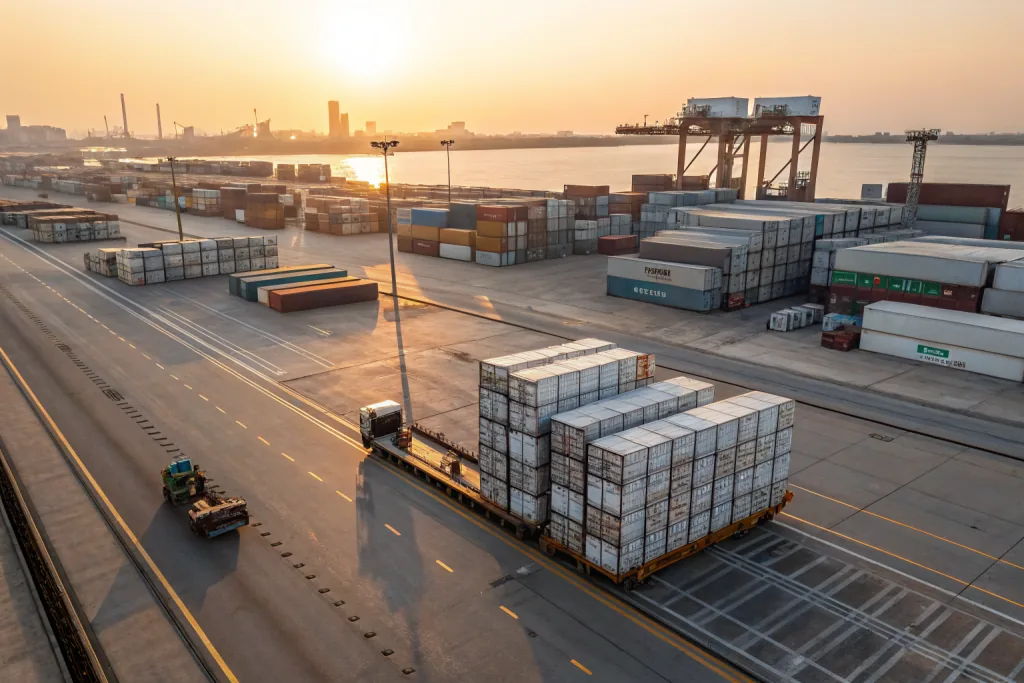
Choose FCL shipping if your cargo fills at least 60% of a 20-foot container (roughly 10+ CBM or 10,000+ kg), as it costs 40-60% less per cubic meter than LCL. Choose LCL if you ship smaller volumes (under 10 CBM), need flexible delivery schedules, or want to avoid paying for empty container space.
Should I Choose LCL or FCL Shipping?
You should choose LCL (Less than Container Load) when shipping 1-10 CBM and FCL (Full Container Load) when shipping 10-33 CBM or 10,000+ kg. The break-even point typically occurs at 10-12 CBM, where FCL becomes more economical despite paying for unused space.
FCL vs LCL Spec Comparison
| Specification | FCL (20ft) | FCL (40ft) | LCL |
|---|---|---|---|
| Volume Capacity | 33 CBM | 67 CBM | 1-15 CBM per shipment |
| Weight Capacity | 21,700 kg | 26,500 kg | 4,000 kg per cubic meter |
| Cost per CBM (China-US West Coast) | $45-75 | $35-55 | $95-180 |
| Transit Time (Port to Port) | 14-18 days | 14-18 days | 18-26 days |
| Port Handling Fees | $300-500 | $400-600 | $50-150 per CBM |
| Customs Inspection Rate | 2-5% | 2-5% | 8-15% |
| Minimum Order | 1 container | 1 container | 1 CBM minimum |
| Security Risk | Low (sealed container) | Low (sealed container) | Higher (consolidated cargo) |
FCL Shipping: Pros and Cons
Advantages:
- 40-60% lower cost per CBM compared to LCL at volumes above 10 CBM
- Faster transit times — 14-18 days vs. 18-26 days for LCL due to no consolidation/deconsolidation
- Lower damage risk — your goods travel in a sealed container without handling by other shippers
- Reduced customs scrutiny — FCL shipments face 2-5% inspection rates vs. 8-15% for LCL
- Fixed costs — predictable pricing regardless of whether you fill 70% or 100% of the container
Disadvantages:
- Higher upfront capital requirement — $2,000-5,000 per container vs. $200-800 for typical LCL shipment
- Inventory carrying costs — tying up capital in larger shipments (30-45 days of inventory vs. 10-15 days)
- Warehouse space requirements — need 2,000+ sq ft to receive and store full container loads
- Less flexibility — harder to split shipments to multiple destinations or adjust quantities
LCL Shipping: Pros and Cons
Advantages:
- Lower entry barrier — start importing with as little as 1 CBM ($200-500 total cost)
- Cash flow efficiency — ship smaller quantities more frequently, reducing inventory investment by 50-70%
- Supplier flexibility — combine goods from 3-5 different factories in single consolidation
- No empty space penalty — pay only for volume shipped, ideal for irregular order sizes
Disadvantages:
- Higher per-unit costs — LCL runs $95-180/CBM vs. $35-75/CBM for FCL on China-US routes
- Consolidation delays — 3-7 days added at origin waiting for container fill; 2-4 days at destination for deconsolidation
- Increased handling damage — cargo moved 4-6 times vs. 1-2 times in FCL
- Hidden fees — CFS (Container Freight Station) charges of $100-300, chassis fees, and higher insurance premiums (0.6-1.2% vs. 0.3-0.5% for FCL)
How Much Does FCL Cost from China to USA?
FCL shipping from China to the USA costs $2,000-4,500 for a 20-foot container and $3,000-6,500 for a 40-foot container, depending on the route, season, and fuel surcharges.
2024 FCL Rate Breakdown (China to USA)
| Route | 20ft Container | 40ft Container | Peak Season Surcharge |
|---|---|---|---|
| Shanghai to Los Angeles | $2,100-2,800 | $3,200-4,200 | +15-25% (Aug-Oct) |
| Shenzhen to Los Angeles | $2,200-2,900 | $3,400-4,400 | +15-25% (Aug-Oct) |
| Ningbo to New York | $3,200-4,100 | $4,800-6,200 | +20-30% (Aug-Oct) |
| Qingdao to Houston | $3,500-4,500 | $5,200-6,500 | +20-30% (Aug-Oct) |
Additional mandatory costs include:
- Origin charges: $300-600 (terminal handling, documentation, customs clearance)
- Destination charges: $500-900 (port fees, chassis, drayage to warehouse)
- Customs clearance: $150-350 (broker fees, ISF filing $25-50)
- Import duties: 0-25% depending on HS code (average 5-8% for consumer goods)
- Insurance: 0.3-0.5% of cargo value
Total landed cost example: A $30,000 FOB shipment in a 20ft container from Shanghai to Los Angeles typically runs $4,200-5,800 all-inclusive, or 14-19% of goods value.
Is FCL Shipping Right for My Business?
FCL shipping is right for your business if you ship 10+ CBM monthly, have $50,000+ annual import volume, maintain 2,000+ sq ft warehouse space, and can finance 30-45 days of inventory.
Choose FCL If You Match These Criteria:
- Volume threshold: Consistent 10-15 CBM per shipment or 120+ CBM annually
- Product profile: Heavy, fragile, or high-value goods where damage risk matters (electronics, glassware, machinery)
- Cash position: Can prepay $3,000-6,000 per shipment without straining working capital
- Storage capacity: Warehouse or 3PL space to receive and hold full container quantities
- Supply chain maturity: Predictable sales velocity to avoid overstock situations
Choose LCL If You Match These Criteria:
- Volume threshold: Under 8 CBM per shipment or testing new products with uncertain demand
- Product profile: Durable, low-value goods where handling damage is acceptable (hardware, textiles, plastics)
- Cash position: Prefer to invest $500-1,500 per shipment and turn inventory 6-8 times yearly
- Storage constraints: Limited warehouse space or using Amazon FBA/3PL with frequent replenishment
- Market testing: Launching new SKUs where demand forecasting is unreliable
Final Recommendation: Making the Switch
Most growing importers start with LCL, then transition to FCL at the 10-12 CBM inflection point. At Mangors Sourcing, we typically see clients make this transition when they reach $300,000-500,000 in annual China imports.
Hybrid approach for scaling businesses: Use FCL for your top 20% of SKUs (80% of volume) and LCL for long-tail products. This optimizes cash flow while capturing FCL economies of scale on core inventory.
As an experienced China sourcing agent, Mangors Sourcing helps small and medium businesses navigate this decision with real freight data from our monthly shipment volume. Our full-service support includes supplier vetting, quality control, shipping optimization, and customs clearance — ensuring you choose the right container strategy for your margins and growth stage.
Ready to optimize your shipping costs? Contact Mangors Sourcing for a free consultation. We’ll analyze your product mix, volume patterns, and warehouse constraints to recommend your optimal FCL/LCL strategy — and handle the entire execution from factory floor to your door.