
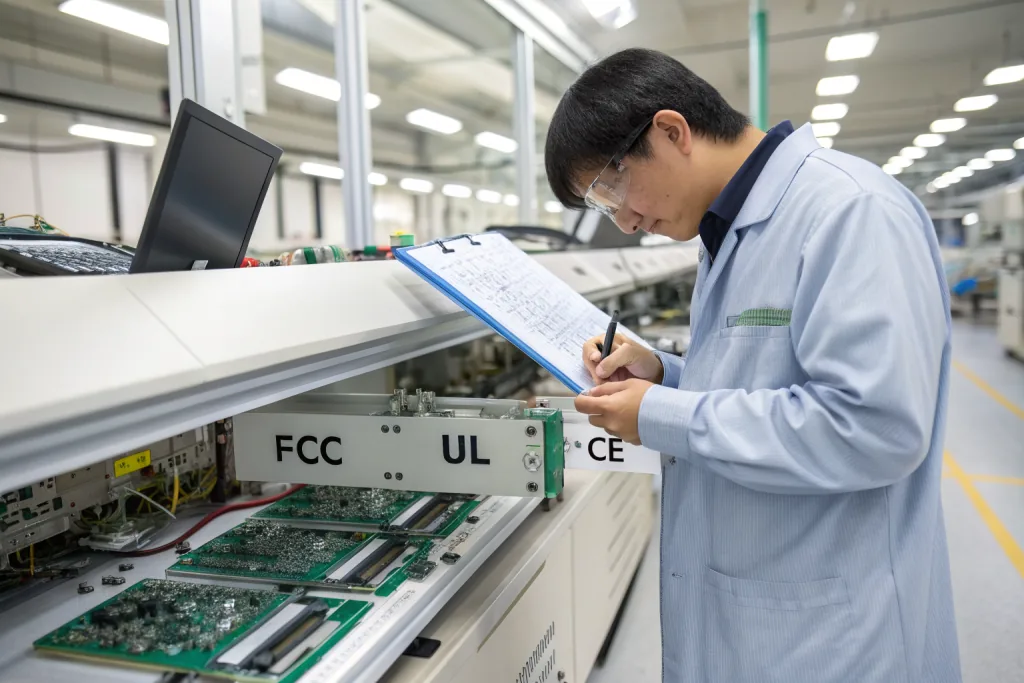
Chinese electronics must meet strict safety standards and certifications before they can be legally resold in the USA and Europe, including FCC, UL, and CE markings depending on your target market. Working with an experienced China sourcing agent like Mangors Sourcing ensures your products pass compliance verification, quality control, and customs clearance without costly delays or rejections.
What Safety Requirements Do Chinese Electronics Need to Resell in the USA?
Electronics imported from China to the USA require FCC certification for electromagnetic interference, UL or ETL listing for electrical safety, and compliance with California Prop 65 for chemical disclosures. These requirements are mandatory and enforced by U.S. Customs and Border Protection, with non-compliant shipments facing detention, fines up to $100,000, or destruction.
FCC Certification (Federal Communications Commission)
All electronic devices that emit radio frequency energy must obtain FCC certification. This includes Bluetooth devices, WiFi equipment, smartphones, and even LED lighting with RF components.
- Cost: $3,000–$15,000 per product depending on complexity
- Timeline: 4–8 weeks for testing and approval
- Valid for: Product lifetime (no renewal required)
UL/ETL Safety Listing
While not federally mandated, most U.S. retailers and commercial buyers require UL or ETL certification for liability protection. This covers power supplies, chargers, batteries, and household appliances.
- Cost: $5,000–$25,000 initial certification
- Factory inspections: $3,000–$5,000 annually
- Timeline: 8–12 weeks
California Proposition 65
Any product containing chemicals known to cause cancer or reproductive harm must carry clear warnings. Electronics with lead solder, phthalates in cables, or lithium batteries fall under this requirement.
| Certification | Required For | Cost Range | Lead Time |
|---|---|---|---|
| FCC Part 15 | RF-emitting devices | $3,000–$15,000 | 4–8 weeks |
| FCC Part 18 | Industrial/consumer ISM equipment | $5,000–$20,000 | 6–10 weeks |
| UL 60950-1 | IT equipment safety | $5,000–$25,000 | 8–12 weeks |
| UL 62368-1 | Audio/video equipment | $6,000–$30,000 | 8–12 weeks |
| Energy Star | Energy-efficient products | $2,000–$8,000 | 4–6 weeks |
Is It Safe to Use Electronics from China?
Electronics manufactured in China are safe to use when sourced from certified factories with proper quality control systems and third-party testing verification. The safety risk comes from uncertified suppliers, counterfeit components, and inadequate inspection—not from Chinese manufacturing itself.
Risk Factors to Address
At Mangors Sourcing, we identify three critical risk areas when vetting electronics suppliers:
- Component substitution: Unauthorized factories may swap specified components for cheaper alternatives after sample approval. This affects 15–20% of first-time orders without proper oversight.
- Battery safety: Lithium-ion batteries require UN38.3 testing and proper MSDS documentation. Defective batteries caused 78 product recalls in the U.S. in 2023, with 60% traced to inadequate cell-level testing.
- Cable and charger quality: Non-UL listed power supplies pose fire risks. We mandate 100% inspection of these components, as they represent 40% of electronics-related safety incidents.
Factory Certification Benchmarks
Safe electronics production requires verified manufacturing standards:
- ISO 9001: Quality management systems (baseline requirement)
- ISO 14001: Environmental management
- IATF 16949: Automotive-grade electronics (highest standard)
- BSCI or SA8000: Social compliance and worker safety
Our supplier vetting process at Mangors Sourcing includes on-site factory audits, production line inspections, and component traceability verification. We reject approximately 35% of initially presented suppliers due to inadequate certification documentation or facility conditions.
What Is the Equivalent of CE Certification in China?
The China Compulsory Certification (CCC or 3C) is the mandatory equivalent of CE marking for products sold within China, covering 158 product categories including most electronics. Unlike CE, which is largely self-certified, CCC requires third-party testing at Chinese government-approved laboratories and factory inspections.
CCC vs. CE: Key Differences
| Aspect | CE Marking (Europe) | CCC Marking (China) |
|---|---|---|
| Legal basis | EU directives, self-declaration | Chinese law, mandatory certification |
| Testing authority | Notified bodies or manufacturer | CNCA-accredited Chinese labs only |
| Factory inspection | Not always required | Mandatory annual audits |
| Cost range | $1,500–$10,000 | $5,000–$20,000+ |
| Timeline | 2–6 weeks | 8–16 weeks |
| Marking validity | Indefinite (with compliance) | 5 years, requires renewal |
Do You Need CCC for Export?
No—CCC certification is only required for products sold in the Chinese domestic market. However, many experienced exporters maintain CCC certification to demonstrate manufacturing capability to international buyers. If your supplier holds valid CCC certification, it indicates they operate under stricter regulatory oversight than non-certified competitors.
Cost Breakdown: Compliance for a Typical Electronics Order
Understanding total landed costs helps you budget accurately. Here’s a realistic example for a $50,000 order of consumer electronics (wireless earbuds, 5,000 units):
| Cost Item | Amount | Notes |
|---|---|---|
| Product FOB price | $50,000 | $10/unit, Shenzhen port |
| FCC certification (if not existing) | $8,000 | One-time, transferable to future orders |
| Third-party pre-shipment inspection | $800 | AQL 2.5 standard, 315-unit sample |
| Sea freight (LCL) | $1,200 | Shenzhen to Los Angeles, 2 CBM |
| Import duties (Section 301) | $6,250 | 12.5% tariff rate for HTS 8518.30.20 |
| Customs broker & ISF filing | $450 | Documentation and entry processing |
| Domestic trucking | $650 | Port to warehouse |
| Total Landed Cost | $67,350 | $13.47/unit effective cost |
Note: Tariff rates for electronics vary significantly by HTS code—some categories face 25% Section 301 tariffs, while others are exempt. Proper classification saves 10–15% in duties.
How Mangors Sourcing Ensures Compliance
As a full-service China sourcing agent, we manage compliance from supplier selection through final delivery. Our process includes:
- Supplier pre-qualification: Verification of existing certifications, factory audits, and reference checks
- Specification alignment: Confirming your target market requirements are built into production standards
- Component traceability: Tracking critical parts to authorized manufacturers (especially batteries and ICs)
- Third-party testing coordination: Managing pre-shipment inspection and laboratory testing
- Documentation packages: Preparing certificates of conformity, test reports, and customs-ready paperwork
We typically reduce compliance-related delays from 3–4 weeks to under 5 days by addressing requirements proactively rather than reactively.
Common Mistakes That Delay Electronics Imports
Based on 500+ electronics sourcing projects, these errors cause the most problems:
- Assuming existing certifications cover your product: FCC and UL certifications are product-specific, not factory-wide. Verify scope before ordering.
- Ignoring power supply specifications: U.S. requires 110–120V/60Hz; European requires 220–240V/50Hz. Dual-voltage designs add $0.50–$1.20 per unit but prevent market restrictions.
- Skipping pre-shipment inspection: At 0.3–0.5% of order value, inspection prevents 5–15% defect rates common in uncertified production.
- Misclassifying HTS codes: Incorrect classification triggers customs holds and penalty assessments. We verify codes against CROSS rulings before shipment.
Ready to Source Electronics from China Safely?
Navigating electronics certifications requires expertise in both technical standards and Chinese supplier management. One compliance error can cost weeks of delays and thousands in remediation.
Contact Mangors Sourcing today for a free consultation. We’ll review your product specifications, identify required certifications for your target markets, and provide a transparent sourcing plan with realistic timelines and costs. Our full-service approach covers supplier vetting, quality control, shipping coordination, and customs clearance—so you receive compliant, market-ready products without the compliance headaches.